
Table of Contents
- Population and land: why prices diverge
- Housing costs: sticker price versus all-in cost
- Crime and safety: reading the statistics
- Gun laws and the right to self-defense
- Taxes and fees: tradeoffs that add up
- Utilities: monthly operating costs
- Recreation and access: what your weekends look like
- Decision framework: which side is right for you?
- Practical checklist before you move
- Is it cheaper to live in Spokane or North Idaho when you consider all costs?
If you are weighing North Idaho vs Eastern Washington for a move, retirement, or simply a lifestyle change, the debate is more than housing price tags. The border between Kootenai County and Spokane County hides a cluster of differences that matter: population density, land ownership, crime, taxes, utilities, access to public land, and the day-to-day feel of community. This guide breaks down those tradeoffs using real numbers and local context so you can decide which side of the border fits your priorities.
Population and Land
Population counts and land ownership patterns are the invisible forces shaping cost and quality of life. Idaho has roughly 2 million residents; Washington about 8.1 million. That simple math—Washington is about four times larger in population—translates into denser urban areas, more services, and different development pressures.
North Idaho (the area around Coeur d'Alene and Kootenai County) may look like there is room to build, but a surprising amount of that surrounding acreage is federally owned public land. That is great for recreation and clean water access, but it limits the buildable inventory and pushes home prices up. In contrast, Spokane and much of eastern Washington have more privately developable land and less federal ownership, which tends to keep housing supply looser and prices lower.
Housing Costs
On paper, housing often looks cheaper on the Washington side. Median home price examples: Spokane County about $415,000 and Kootenai County (North Idaho) around $550,000. That difference seems obvious: a lower purchase price usually means smaller monthly payments. But there are additional angles to consider before making a decision.
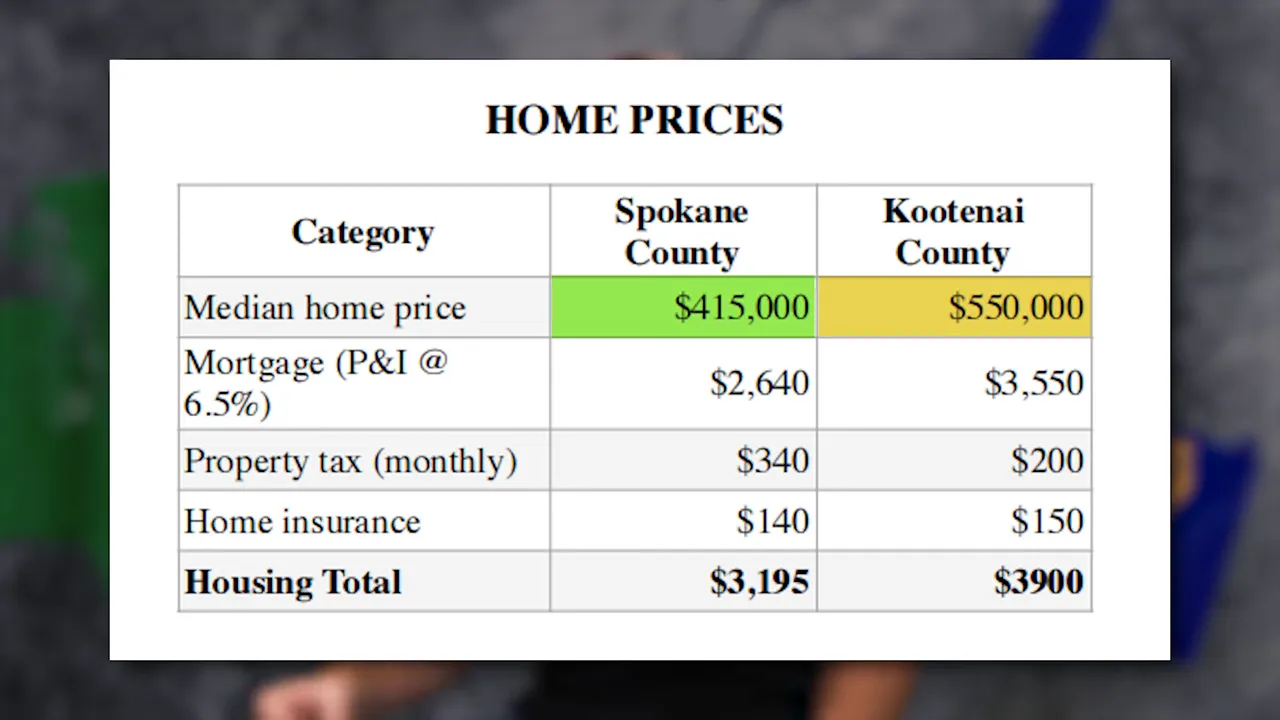
Using a practical sample household—a married couple, no children, one income, owning a single family home at the area median—here are a few monthly line items to compare:
- Mortgage principal and interest: roughly $26.40 per $1,000 of loan in Spokane vs about $35.50 per $1,000 in Kootenai County (estimates used to show the relative difference).
- Property tax: about $340/month in Spokane vs roughly $200/month in Kootenai County.
- Home insurance: roughly $140/month in Spokane and about $150/month in Kootenai County.
When those pieces are added, the sample monthly housing cost comes out to about $3,195 in Spokane and around $3,900 in Kootenai County. That makes North Idaho more expensive monthly for this sample, largely because of the higher purchase price.
What you get for your money
Price is not only about dollars; it is about what those dollars buy. Houses in Spokane more often show their age: many are not updated or well maintained. Some neighborhoods bring tradeoffs—proximity to major arterial roads, flight paths from an international airport, or commercial uses that affect daily life. In many parts of Kootenai County, properties are newer, better maintained, and surrounded by more consistently desirable neighborhoods.
In addition to quieter neighborhoods, North Idaho offers easier access to clean lakes, more trails right out the door, and lots of nearby public land for outdoor recreation. That access is a major intangible that makes the higher price feel justified to many residents.
Crime and safety: reading the statistics
Safety is one of the first things people notice when they move. Data and lived experience both matter. Here are comparative figures that highlight a meaningful gap:
- Overall crime rate: Kootenai County roughly 1,197 per 100,000 vs Spokane about 5,500 per 100,000.
- Violent crime: Kootenai around 241 per 100,000 vs Spokane at 675 per 100,000.
- Property crime: Kootenai is under 1,000 per 100,000, Spokane approaches 5,000 per 100,000.
- Odds perspective: violent crime odds roughly 1 in 414 in Kootenai vs 1 in 148 in Spokane; property crime about 1 in 105 vs 1 in 21; any crime 1 in 84 vs 1 in 19.
Those differences show Spokane experiences far more crime on multiple measures. Many people report a different sense of comfort walking downtown or visiting public spaces at night. That matters if your lifestyle includes frequent downtown dining, evening strolls, or leaving a home unattended for longer seasons.
Gun Laws and the Right to Self-Defense
If firearm law and the right to carry matter to you, there is a sharp legislative contrast between the two states:
- Idaho: constitutional carry for those 18 and older, no statewide bans on assault weapons, and no magazine capacity restrictions in state law. Firearm transfers and purchases generally have fewer state-level hurdles.
- Washington: more regulation. Assault weapon bans in some jurisdictions, magazine capacity limits, permit required for concealed carry, a 10-day waiting period on many purchases, and universal background checks on private transfers.
Put plainly: Idaho prioritizes permissive carry and protections for firearm owners; Washington has more restrictions and regulatory steps. That difference affects daily life for people who carry, but it also factors into community attitudes and policy choices that shape residency decisions.
Taxes and Fees
Taxes are often where the conversation gets animated. Washington famously has no statewide personal income tax. That headline draws attention, but the full story includes other taxes that can shift the balance.
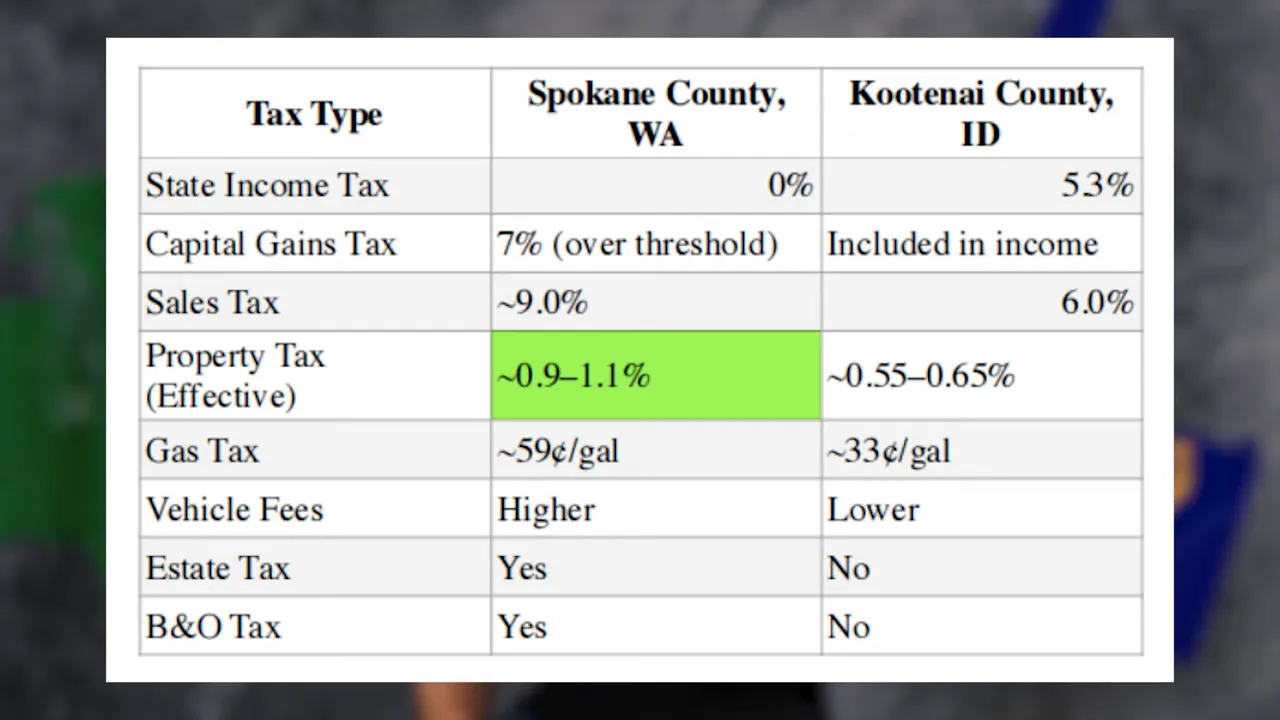
Key tax differences to understand:
- State income tax: Washington currently has no personal income tax; Idaho imposes a flat rate in the range discussed here of about 5.3%.
- Capital gains: Idaho includes capital gains within taxable income; Washington does not tax income but has other business taxes that impact capital-intensive activity.
- Property tax: examples show Washington county rates closer to 0.9 to 1.1% of home value while Kootenai County may be around 0.55 to 0.65%.
- Gas tax: Washington is higher—about $0.59 per gallon vs Idaho at about $0.33 per gallon. That adds up for drivers.
- Vehicle fees and registration: generally higher in Washington, with larger registration and related fees on newer or high-value vehicles.
- Estate tax: Washington imposes an estate tax on estates above certain thresholds (noted here around $3 million); Idaho does not have the same estate tax.
- B and O tax (Business and Occupation): Washington taxes gross receipts, not net income, which can be a heavy burden for small businesses or self-employed residents with thin margins. Idaho is seen as more friendly to small businesses on this front.
The broad takeaway: Washington collects revenue in different ways than Idaho. No personal income tax does not mean no state-level tax burden; business taxes, estate taxes, gas taxes, and higher vehicle fees are part of the mix.
Utilities: Monthly Operating Costs
Utility costs also matter and can change monthly budgeting. For an average-priced home here are sample monthly averages:
- Electricity: Spokane about $160 vs Kootenai around $110.
- Natural gas: Spokane roughly $130 vs Kootenai about $95.
- Water and sewer: Spokane about $125 vs Kootenai closer to $75.
- Garbage: Spokane ~$50 vs Kootenai ~$35.
Total example monthly utilities land near $465 in Spokane and around $315 in Kootenai County. Older houses, poor insulation, southern exposure, or properties in heavy snow areas will change those numbers—so always check historic utility bills before buying.
Recreation and Access
Lifestyle differences are often the deciding factor. For outdoor lovers:
- North Idaho gives faster access to more ski hills. Coeur d'Alene area residents can reach four significant ski resorts within an hour; Spokane has one within that hour and the others require additional drive time.
- Kootenai County has roughly twice as much public land available nearby, meaning less crowding on trails and easier access to lakes and dispersed recreation.
- Both areas boast dozens of lakes, rivers, and trails, but North Idaho’s smaller population spreads people out more on warm weekends.
Food and nightlife tend to be stronger downtown in Spokane—more restaurants and a livelier urban scene. North Idaho prioritizes a smaller-town feel, quieter evenings, and community-focused events.

North Idaho vs Eastern Washington: Which Side is Right For You?
Choosing between North Idaho vs Eastern Washington becomes clearer when you rank your priorities. Here are common decision paths:
- Prioritize safety, outdoor access, and a smaller community: lean toward North Idaho. Expect higher housing purchase costs but lower crime, easier access to public land, and a tighter community feel.
- Prioritize lower upfront housing price, more urban convenience, and restaurants: Eastern Washington (Spokane) can provide more affordable home purchase options and a richer downtown scene, but expect higher crime statistics and more urban challenges.
- Self-employed or small-business owner concerned about state taxes: Idaho’s business climate tends to be friendlier, while Washington’s B and O tax and other fees can hit small margins hard.
- Drivers who log a lot of miles: Idaho’s lower gas tax and generally lower vehicle fees translate into yearly savings that compound.
- Firearm owners focused on permissive carrying laws: Idaho has a more permissive legal framework for carrying and firearm ownership.
Ask yourself practical questions: How often will I commute? How important is nightlife versus trail access? Do I plan to run a small business? Is lower crime a hard requirement? Answer those first, then let the numbers refine the choice.
If you need help figuring out which side best fits your priorities, reach out and we’ll walk through the numbers, neighborhoods, and tradeoffs with you. Call or text us at 208-907-5757 to schedule a free consultation.
Practical Checklist Before You Move
- Compare actual home totals: look at mortgage, taxes, insurance, utilities, and HOA fees for each property—request two years of utility bills when possible.
- Walk the neighborhood at different times of day to get a feel for safety and activity.
- Check recent crime reports and contact local police non-emergency lines with questions about neighborhood trends.
- Review business and estate tax implications with a local CPA if you have a small business or a high net worth.
- Plan recreation logistics: driving time to favorite ski hills or lakes matters; weekend congestion can add 30 to 60 minutes on peak days.
- Budget for contingencies: alarm systems, cameras, or additional home upgrades if moving into an older house in Spokane.
FAQs about North Idaho vs Eastern Washington
Is it cheaper to live in Spokane or North Idaho when you consider all costs?
On paper, monthly payment pressure is often lower in Spokane because the purchase price is lower. But when you factor in property maintenance, neighborhood desirability, safety concerns, and the lifestyle value of public land access, North Idaho remains appealing to those who can afford the higher upfront cost. The real answer depends on which costs and tradeoffs you value most.
How big is the crime difference between Spokane and Kootenai County?
The difference is significant: overall crime rates in Spokane are roughly five times higher per 100,000 residents compared to Kootenai County in the examples used. Violent and property crimes both show sharp disparities, and that influences personal comfort and neighborhood choices.
Do I save money on taxes by moving from Washington to Idaho?
It depends. Washington does not have a personal income tax, but it has higher gas taxes, vehicle fees, an estate tax, and the B and O tax which affects businesses. Idaho does have state income tax but tends to be friendlier to small business owners and has lower gas and vehicle fees. Review your income sources, business structure, and long-term estate plans with an accountant to make an informed decision.
Are utilities much more expensive in Spokane?
Sample monthly utility figures show Spokane higher by roughly $150 per month for a typical home. Actual costs vary by property condition, insulation, home size, and appliance efficiency. Ask sellers for recent bills to estimate true operating costs.
Which area has better access to ski resorts and outdoor recreation?
North Idaho typically has faster access to multiple ski resorts—four significant options within about an hour of Coeur d'Alene—while Spokane has one within that same time and requires longer drives for others. North Idaho also offers more nearby public land per capita, which reduces crowding on trails.
Should I rule out Spokane entirely if gun laws or politics bother me?
Not necessarily. If occasional trips into North Idaho are part of your lifestyle and home ownership in Spokane is financially necessary, many people split time across the border. However, if state-level laws are a central value, that should weigh heavily in your decision.
What is the single most important tip for someone choosing between North Idaho vs Eastern Washington?
Rank your non-negotiables first: safety, access to nature, taxes, business environment, and budget. Use those priorities to filter neighborhoods and properties, then compare real all-in monthly costs and lifestyle access before committing.
Choosing between North Idaho vs Eastern Washington is a classic example of tradeoffs. One side offers lower sticker prices and a livelier downtown; the other gives quieter neighborhoods, better access to lakes, and lower crime. Both are beautiful and full of outdoor opportunities. Define what matters most to your daily life and finances, check the numbers on the properties you love, and make the decision that fits your priorities.