

Idaho Just Rewrote Your Property Rights: 4 New Laws Nobody Told You About

The Idaho Legislature passed four housing laws that took effect July 1, 2026, and most property owners in North Idaho have no idea what actually changed. The headlines got it wrong. I read the bills so you don't have to.

These aren't minor tweaks to city ordinances. These are statewide changes that affect what gets built next to your house, what you can build on your own land, how short-term rentals are regulated, and how fast you can remove squatters. If you own property in Coeur d'Alene, Post Falls, Hayden, Rathdrum, or Sandpoint, or you're thinking about buying here, you need to understand what these laws actually say, not what the internet says they say.

I'm breaking down SB 1352 (the starter home law), SB 1354 (the ADU law), HB 583 (the short-term rental law), and HB 321 (the squatter removal law) in plain English. No legal jargon. No political spin. Just what changed, what your city can still control, and how it affects you as a homeowner, buyer, seller, or investor in North Idaho.

Table of Contents

What Gets Built Next to You: SB 1352 and Manufactured Homes

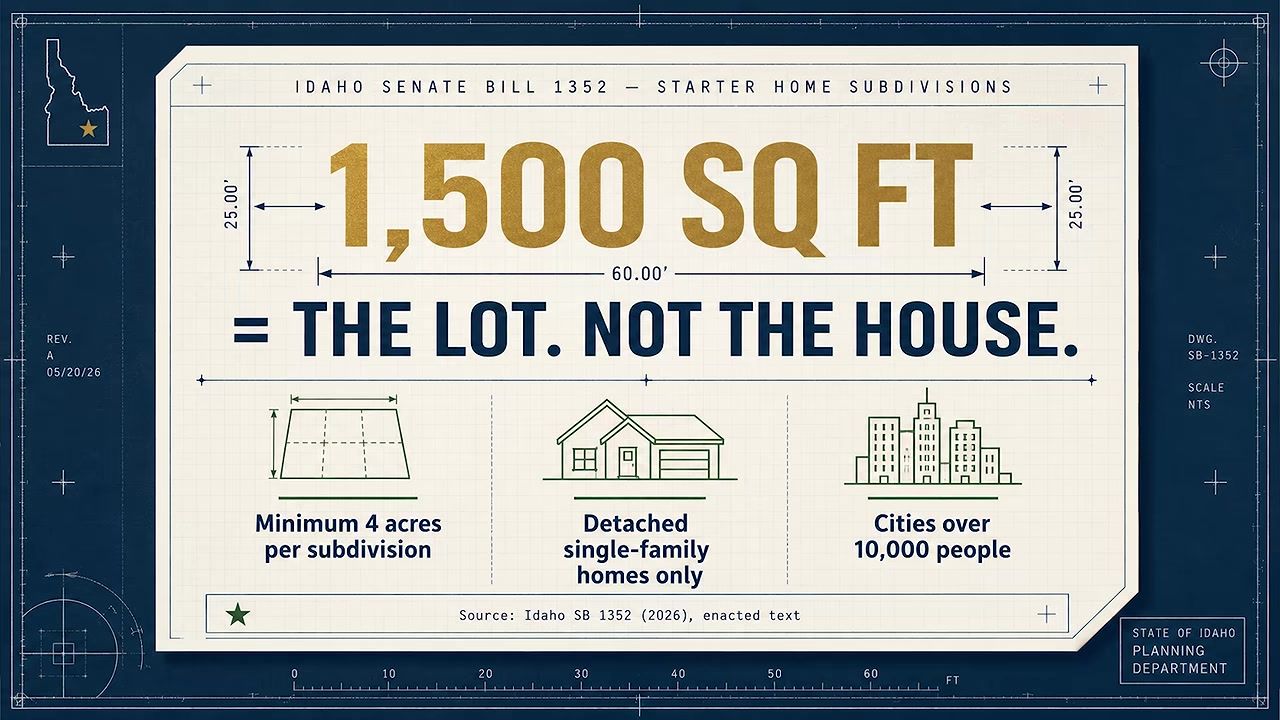
SB 1352 is the starter home law, and the headlines made it sound like Idaho just legalized 1,500-square-foot lots everywhere. That's not what happened. This law applies only to cities with populations over 10,000 people, Coeur d'Alene, Post Falls, Hayden, Rathdrum, and Sandpoint in North Idaho, and it legalizes compact single-family subdivisions with lots as small as 1,500 square feet. Not 1,500-square-foot houses. 1,500-square-foot *lots*.

The goal is to allow smaller, more affordable single-family homes in areas where land costs are pricing out first-time buyers. These aren't apartments or condos. They're detached single-family homes on smaller parcels. Think of it as the state saying cities can't require every new lot to be a quarter-acre or larger if a developer wants to build entry-level housing.

HB 800, the manufactured home law, runs parallel to this. It prevents cities from banning manufactured homes outright in residential zones. If a manufactured home meets the same building codes and aesthetic standards as a site-built home, cities can't treat it differently. This is a big deal for buyers who want affordability but have been shut out by zoning rules that treated manufactured homes as second-class housing.

Both laws are about expanding supply at the lower end of the market. Whether you think that's good or bad depends on whether you're trying to buy your first home or whether you're worried about density increasing in your neighborhood.

What Your City Still Controls

Here's the catch: SB 1352 doesn't strip cities of all zoning authority. Your city still controls setbacks, building height, parking requirements, design standards, and infrastructure. A developer can't just cram ten tiny houses on a lot with no utilities and call it legal. The city can still require roads, water, sewer, and stormwater management. They can still enforce building codes. They can still say no if the project doesn't meet those standards.

What they *can't* do anymore is reject a subdivision solely because the lots are smaller than the old minimum. If a developer meets every other requirement, the city has to approve it. That's the shift. It's not a free-for-all. It's a narrower path for cities to block compact housing.

Coeur d'Alene's reaction to these laws has been cautious. City staff have said they're reviewing how the new rules interact with existing zoning, especially in established neighborhoods where lot sizes have been larger for decades. The city still has tools to manage growth, they just can't use lot size as the primary reason to say no anymore.

What You Can Build Now: The ADU Law (SB 1354)

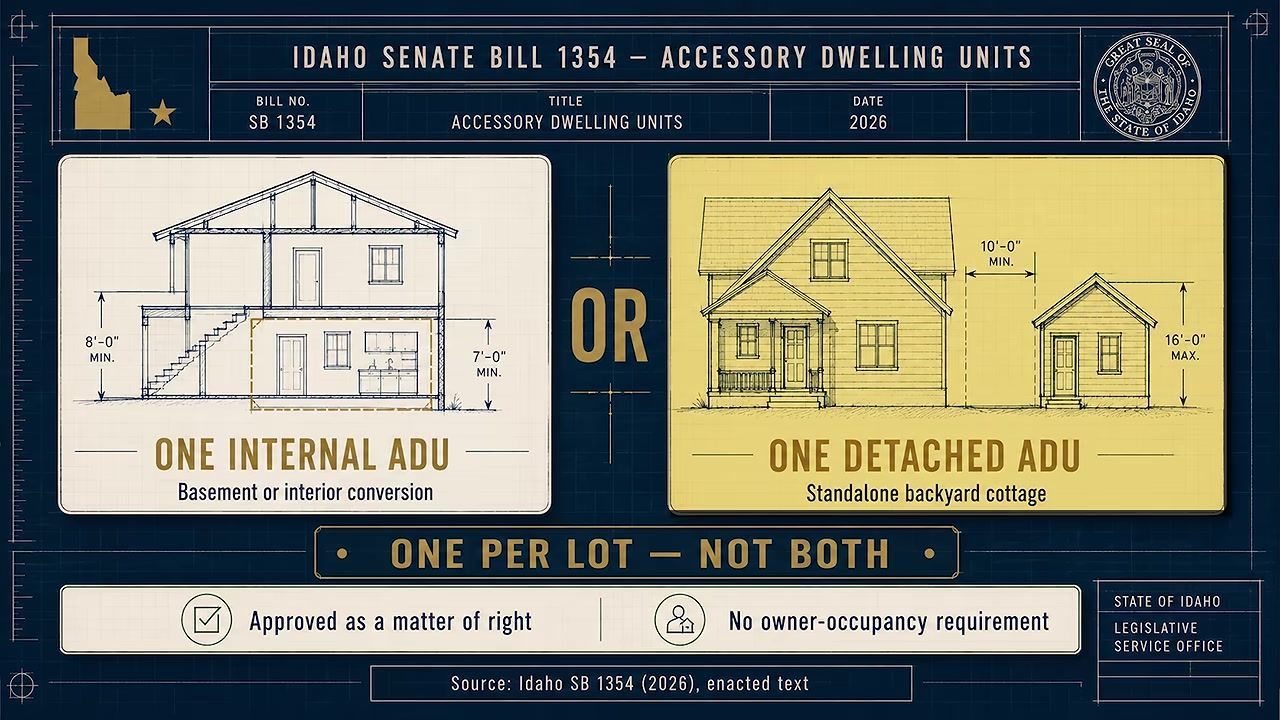
SB 1354 is the accessory dwelling unit law, and it's the one that affects the most homeowners directly. Accessory dwelling units, ADUs, are now allowed by right in cities over 10,000 people. That means if you own a single-family home in Coeur d'Alene, Post Falls, Hayden, Rathdrum, or Sandpoint, you can build a second, smaller dwelling on your property without asking for a special permit or variance.

An ADU can be a detached cottage in the backyard, a converted garage, or a basement apartment. The law doesn't specify a size limit, but cities can still regulate dimensions, setbacks, and parking. What they can't do is ban ADUs outright or make the approval process so onerous that nobody bothers.

You can rent out an ADU. That's explicitly allowed. Whether you rent it long-term to a tenant, short-term as a vacation rental, or let a family member live there rent-free is up to you. The state isn't dictating how you use it, only that cities must allow it.

There's also a financing lot-split provision in HB 707 that ties into this. If you build an ADU and want to finance it separately from your primary residence, you may be able to split the lot for lending purposes without going through a full subdivision process. This is still being worked out at the local level, but the intent is to make it easier to get construction loans for ADUs without the cost and delay of a formal plat.

The HOA Trap That'll Cost People Money

Here's where people are going to lose money: the ADU law applies to cities, not homeowners associations. If your HOA has covenants that prohibit accessory structures, outbuildings, or rental units, those covenants are still enforceable. The state law doesn't override private contracts.

I've already talked to buyers who assumed they could build an ADU because the law passed, only to find out their HOA bylaws say no. You can fight it, some HOAs will amend their rules, especially if enough homeowners want the change, but you can't just ignore the covenants and build anyway. You'll end up in a legal mess, and the HOA will win.

Before you buy a property planning to add an ADU, read the CC&Rs. If the HOA restricts accessory dwellings, factor that into your decision. Don't assume the state law gives you blanket permission.

The Short-Term Rental Law (HB 583)

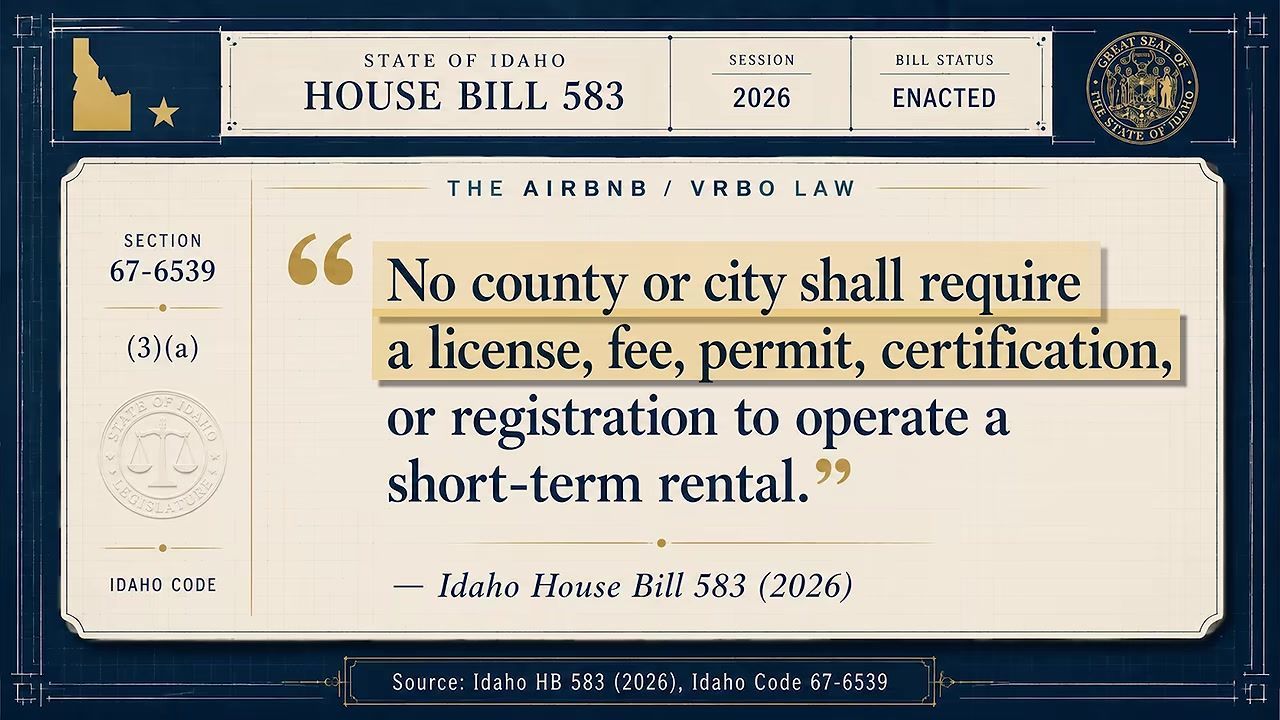
HB 583 is the short-term rental law, and it's the one that caused the most noise in resort towns like Sandpoint. Cities can no longer require a short-term rental permit, license, or registration. If you own a house and want to list it on Airbnb or Vrbo, the city can't make you apply for permission first.

Sandpoint and Bonner County had to roll back their short-term rental ordinances. They used to require permits, inspections, and annual renewals. That's gone. You can now rent your property short-term without notifying the city.

But, and this is important, "less regulation" doesn't mean tax-free. You still owe lodging taxes. You still have to follow building codes, fire safety rules, and occupancy limits. You still have to deal with neighbor complaints if your guests are loud. The city just can't require you to get a license before you start.

This law is a win for property owners who want flexibility and a loss for neighbors who were relying on the permit process to keep short-term rentals out of residential areas. The state decided that property rights outweigh neighborhood control on this one.

If you're buying in North Idaho as an investment property, this law makes short-term rentals easier to operate. If you're buying as a primary residence in a neighborhood that's turning into a hotel district, you now have fewer tools to push back.

Getting Squatters Off Your Property (HB 321)

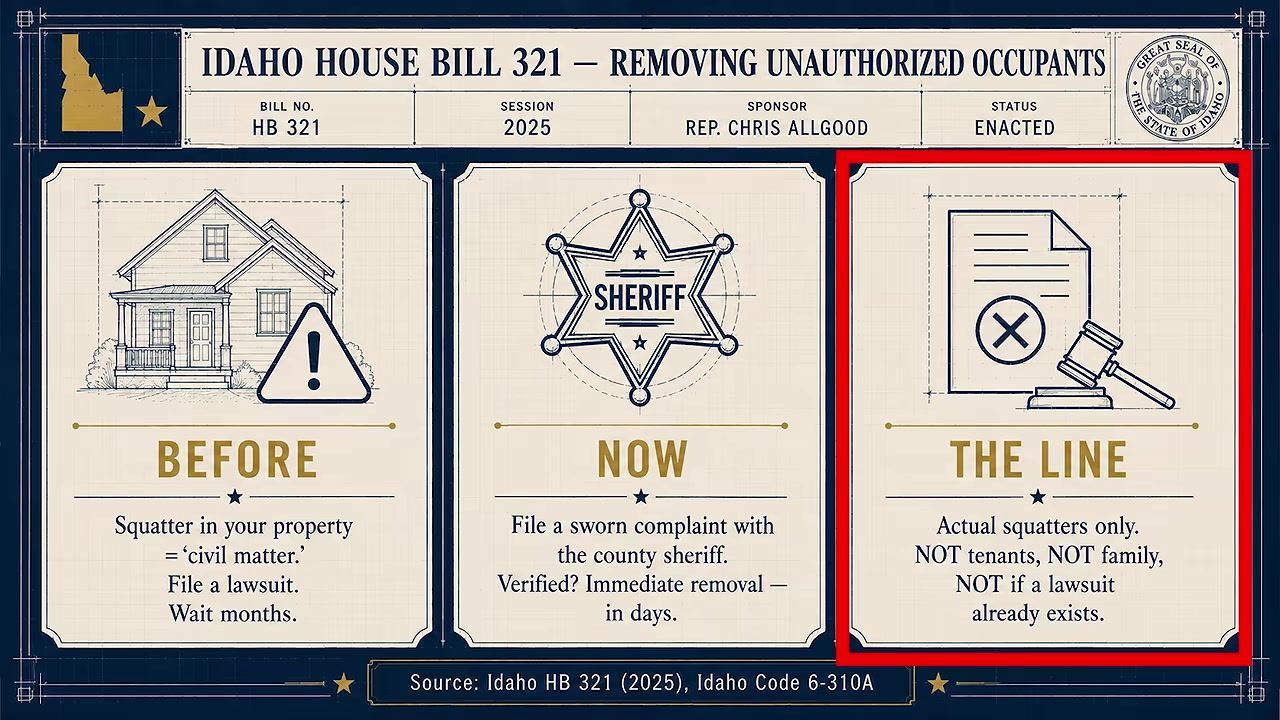
HB 321 is the squatter removal law, and it's straightforward. If someone is occupying your property without permission, not a tenant with a lease, but an unauthorized occupant, you can now use a sheriff-assisted process to remove them faster.

Before this law, removing a squatter often required a full eviction process, which could take weeks or months. Now, if you can prove you own the property and the occupant has no legal right to be there, the sheriff can remove them without a lengthy court hearing.

This law matters most for vacant properties, second homes, and investment properties that sit empty between tenants. It's not a tool for landlords to bypass eviction law, if someone has a lease or tenant rights, you still have to follow the eviction process. But if someone breaks into a vacant house and claims squatter's rights, you can get them out faster.

For buyers, this is a minor but useful protection. If you buy a property and discover someone living there who shouldn't be, you're not stuck in legal limbo for months.

What Idaho Still Won't Let Your City Do

Despite all these changes, there's one thing Idaho still won't let cities do: enact rent control. The state has a long-standing prohibition on local rent control ordinances, and none of these new laws change that. Cities can't cap rents, limit rent increases, or require landlords to offer below-market leases.

This comes up every time housing costs spike. Advocates push for rent control, and the state legislature says no. Whether you agree with that or not, it's the reality. If you're moving to North Idaho expecting rent stabilization, it's not happening.

Who Wins and Who Loses

You win if you're a first-time buyer who needs a smaller, more affordable home. SB 1352 and HB 800 expand your options.

You win if you own a single-family home and want to build an ADU for rental income, a family member, or future resale value. SB 1354 gives you that right.

You win if you own a property and want to rent it short-term without city red tape. HB 583 removes the permit barrier.

You win if you own vacant land or investment property and need a faster way to remove squatters. HB 321 speeds up the process.

You lose if you bought in a neighborhood expecting lot sizes and density to stay the same. SB 1352 allows more compact development next to you.

You lose if you were relying on city short-term rental rules to keep your street residential. HB 583 took that tool away.

You lose if your HOA restricts ADUs and you didn't read the covenants before buying. The state law doesn't override private contracts.

These laws shift power from cities to property owners. Whether that's good depends on which side of the property line you're on.

Ready to Buy, Sell, or Invest in North Idaho?

If you're thinking about moving to North Idaho, buying your first home, selling, or adding an investment property, these laws change the math. What you can build, what gets built next to you, and how you can use your property are all different now than they were a year ago.

I've been here for 34 years, and I help people relocate to Coeur d'Alene, Post Falls, Hayden, Rathdrum, and Sandpoint every week. Let's talk about how these changes affect your specific situation, whether you're looking for a starter home, a property with ADU potential, or an investment that pencils under the new short-term rental rules.

Reach out, call or send me an email and we'll walk through your goals, your timeline, and what's actually available in today's market. No pressure. Just honest answers from someone who knows these towns and these laws inside out.

FAQ: Idaho Property Rights Laws 2026

Can cities in Idaho still require minimum lot sizes?

Cities over 10,000 people cannot reject a subdivision solely because lots are smaller than 1,500 square feet, but they can still enforce setbacks, parking, infrastructure, and design standards. Smaller cities and counties retain full control over lot size minimums.

Do I need HOA approval to build an ADU in Idaho?

Yes. SB 1354 requires cities to allow ADUs, but it does not override HOA covenants. If your HOA restricts accessory structures or rental units, you must follow those rules or petition the HOA to amend them.

Can I rent out my ADU as a short-term rental in North Idaho?

Yes. The ADU law allows you to rent your accessory dwelling unit long-term or short-term. HB 583 removed city permit requirements for short-term rentals, so you can list an ADU on Airbnb or Vrbo without a city license, though you still owe lodging taxes.

Does the new Idaho squatter law apply to tenants?

No. HB 321 applies only to unauthorized occupants with no legal right to be on your property. If someone has a lease or established tenant rights, you must follow the standard eviction process.

Which North Idaho cities are affected by these laws?

Cities with populations over 10,000 are subject to SB 1352, SB 1354, and HB 583. In North Idaho, that includes Coeur d'Alene, Post Falls, Hayden, Rathdrum, and Sandpoint. Smaller towns and unincorporated Bonner and Kootenai County areas are not required to follow these rules.

Can my city still regulate ADU size and design?

Yes. Cities must allow ADUs, but they can regulate dimensions, setbacks, parking, building materials, and design standards as long as those rules don't make ADUs effectively impossible to build.

Living Life Realty Group

MOVING TO North Idaho

Guide titled "Living in North Idaho" over an aerial view of a city with a lake.

WATCH OUR VIDEOS

Share this article

Recent Posts

Then July hits and they're sitting in traffic in the town they moved to escape traffic.
By Trent Grandstaff • September 17, 2026
Thinking about moving to North Idaho? Compare Coeur d'Alene, Sandpoint, and Hayden for lifestyle, convenience, isolation, and real estate.
Text reading “IDAHOANS NEVER FORGIVE” beside a man’s portrait and a crossed-out sign in a forested landscape
By Trent Grandstaff • August 21, 2026
Moving to Idaho? Learn 10 things newcomers do that can hurt their reputation, from private land and winter prep to respecting small-town life.
Man standing before Priest Lake, Idaho, with sunset over water and forested shoreline; large title text above
By Trent Grandstaff • August 7, 2026
Thinking about moving to Priest Lake, Idaho? Get the real scoop on remote living: one-road access, housing, plus whether Priest Lake is actually a good fit for you.

Man standing between rustic cabins, with bold red text “WHAT HAPPENED?” and a red arrow pointing left.
By Trent Grandstaff • July 31, 2026
Thinking about living in Idaho, especially North Idaho? Read the hard truths behind rising recreation costs and the quiet (and pricey) lifestyle beyond Boise.
Man in black shirt over sunset cityscape with red text “-$36,000,000” and “POST FALLS”
By Trent Grandstaff • July 17, 2026
North Idaho real estate growth is colliding with Idaho’s 8% property-tax budget cap. Learn how it impacts Kootenai County buyers, sellers, and growth.

“PRIest River, ID” thumbnail with a man centered before mountains and four others in a scenic outdoor setting
By Trent Grandstaff • July 10, 2026
An honest guide to living in Priest River, Idaho-housing and costs, off-grid potential, weather, and the shopping trade-offs of North Idaho’s quiet corner.

Bold “IT’S ON US” text over a man centered in front of a sunset mountain scene with four people behind him
By Trent Grandsatff • July 3, 2026
Thinking about moving to Idaho? Discover why Idaho's culture is changing and what locals hope new residents understand.
Man in black shirt between two rustic cabins at sunset, with red text “DON’T BUY THESE” and arrows pointing to them
By Trent Grandstaff • June 26, 2026
North Idaho real estate is cooling. See how affordability, property type, and resale demand are shifting and what buyers should consider before making a move.

Mountain road scene with three men and bold text “STAY OUT!” over dramatic, smoky hills.
By Trent Grandstaff • June 12, 2026
Thinking about moving to North Idaho? Compare St. Maries, Blanchard, and Silver Valley before choosing the right rural lifestyle.
Man in plaid shirt at sunset skyline with bold text “250K vs 750K”
By Trent Grandstaff • April 22, 2026
Compare Boise vs. Coeur d’Alene on housing, cost of living, weather, politics, outdoor access, population, and lifestyle to find your best fit.