
North Idaho real estate has been one of the most talked about markets in the country for years. People have poured into Kootenai County looking for freedom, property rights, a lower tax burden, and a place that still feels like the America they remember growing up in. For plenty of homeowners, business owners, and entrepreneurs, that growth has been an absolute gift.
Home values climbed. Equity grew. New restaurants, services, construction projects, and businesses showed up in communities that used to be pretty dang quiet.
But there is a serious issue underneath all of that growth. It is not simply a supply-and-demand problem, and it is not a story about local leaders being irresponsible with money. It is a structural trap built into Idaho law, and it affects nearly every conversation around North Idaho real estate.
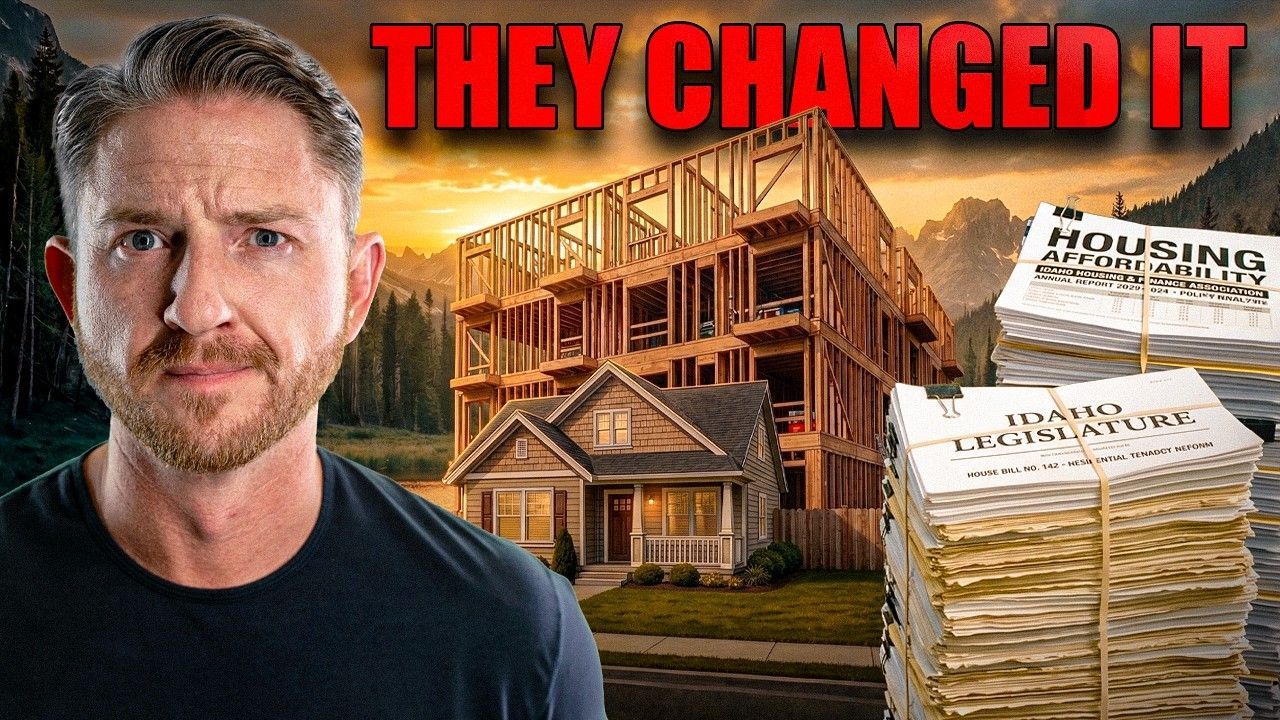
The issue is Idaho Code 63-802, a property-tax budget limitation that caps how quickly cities and counties can grow their budgets. That cap may have made sense in a very different Idaho. In today’s Kootenai County, where population and service demands are rising quickly, the math is getting ugly.
Key Takeaways
- Idaho Code 63-802 limits annual local property-tax revenue growth to 8%, even as population and service costs rise.
- Post Falls reported a negative $36 million net fiscal position, with low-density housing creating a net loss per acre.
- Kootenai County faces public-safety strain, including a jail operating at roughly 143% of capacity.
- For buyers and sellers, decisions should be based on personal equity, budget, timing, and long-term plans rather than hopes for a quick correction.
Table of Contents
- Why People Continue Moving to North Idaho
- The Law at the Center of the Problem
- Post Falls Shows Why Growth Does Not Automatically Pay for Itself
- Hayden and the Cost of Public Safety
- The Kootenai County Jail Is Already Over Capacity
- Why More Affordable Housing Does Not Automatically Solve It
- This Is a Structural Problem, Not a Local-Leader Problem
- What This Means for North Idaho Real Estate Owners
- Should We Buy North Idaho Real Estate Right Now?
- The Honest Bottom Line
Why People Continue Moving to North Idaho
Let’s be honest, people generally are not moving here because they enjoy scraping ice off their windshield six months out of the year. Some probably are, and those people are built a little different.
Most people come for something much bigger. Idaho has built a reputation as a place with limited government, personal freedom, constitutional carry, lower income taxes, and property rights that still carry real weight. That pitch resonates with people who feel like their former state has become too expensive, too restrictive, or too disconnected from how they want to live.
That demand has landed heavily in Kootenai County. North Idaho real estate has become especially attractive to people relocating from higher-cost markets, as well as people seeking more space, outdoor access, and a different pace of life.

Growth has created real benefits:
- Longtime homeowners have seen substantial appreciation and equity growth.
- Local small businesses have gained more customers and more spending activity.
- New services, restaurants, employment centers, and construction projects have expanded the economy.
- North Idaho real estate has become a meaningful wealth-building asset for many owners.
That is all real. But communities do not just absorb new residents on paper. Every new household also requires roads, police coverage, fire response, schools, parks, water systems, jail capacity, planning staff, and a whole lot more.
The Law at the Center of the Problem
Idaho Code 63-802 limits cities and counties to an 8% annual increase in property-tax revenue budgets. In plain English, even if a community experiences explosive growth, the local government’s property-tax revenue growth is still capped.
It does not matter if the population doubles. It does not matter if the costs of labor, equipment, public safety, construction, or infrastructure rise far faster than expected. It does not matter if hundreds of people are arriving every month. The ceiling is still 8%.
That is where North Idaho real estate becomes more complicated than simply asking whether there are enough homes available.
The law was written in the 1970s, when government costs were expected to rise slowly and predictably. But the modern cost of providing public services looks nothing like it did fifty years ago. A fully equipped police patrol car that cost about $3,500 in the 1970s would be roughly $20,000 to $25,000 today using ordinary inflation math. The actual price of a fully equipped patrol vehicle today is closer to $75,000.
That gap tells the story. Local governments are trying to operate under a formula designed for a far cheaper world. They can try to become more efficient, and they absolutely should, but efficiency alone does not fix a structural revenue mismatch.
Post Falls Shows Why Growth Does Not Automatically Pay for Itself
One of the biggest misconceptions in North Idaho real estate is that every new subdivision automatically makes a city stronger financially. It sounds logical. More homes should mean more taxpayers, more economic activity, and more money for services.
But the fiscal analysis from Post Falls tells a different story.
Post Falls, one of Idaho’s fastest-growing cities, reported a net fiscal position of negative $36 million in its public works data for 2025. This is not a rumor, and it is not a made-up internet headline. It is the city’s own fiscal analysis.
The more surprising detail is how different land uses affect the city’s bottom line. According to that analysis, low-density single-family housing generates a net fiscal loss of about $7,400 per acre. Meanwhile, mixed-use development produces about $167,000 per acre in net positive revenue.

That does not mean single-family homes are bad. They are what many families want, and they are a major part of why people are drawn to North Idaho real estate in the first place. The problem is the long-term cost structure. Single-family subdivisions need streets, utilities, police and fire coverage, school capacity, and ongoing maintenance spread over fewer taxable acres.
Mixed-use projects create a different revenue picture because they combine commercial activity, housing, and greater density. Yet the housing product most locals want can be the very product that deepens the fiscal hole.
Hayden and the Cost of Public Safety
Hayden provides a very real example of how quickly service costs can overwhelm a local budget. The city does not operate its own police department. Instead, it contracts with the Kootenai County Sheriff’s Office.
That contract had been about $1.04 million annually. Once the county moved to a true-cost model, meaning Hayden would pay the actual full cost of deputy coverage, the figure jumped to approximately $1.8 million per year.
That is a 73% increase. Hayden has indicated that under its current budget, it can afford five deputies. Meanwhile, the county ends up absorbing public-safety costs for cities that simply cannot afford to build and operate their own departments.
This is not about blaming Hayden. It is about recognizing the position local governments have been placed in. North Idaho real estate growth creates demand for public safety, but the available local funding tools have not kept pace with the demand.
The Kootenai County Jail Is Already Over Capacity
If we want to understand what the budget problem looks like when it reaches a breaking point, look at the Kootenai County Jail.
The jail has 451 beds. It was housing 483 inmates and had peaked at 517. That placed it at roughly 143% of capacity. The overcrowding was serious enough that the Sheriff’s Office asked local law enforcement to use discretion with misdemeanor arrests because there was physically no room.
The jail failed its last state inspection because of overcrowding. At the same time, the county was spending $8.9 million to finish two dormitory pods that had sat as empty concrete shells since 2018.
That is the ground-level consequence of a fiscal system that cannot adjust quickly enough. The result is not some abstract budget spreadsheet. It means strained emergency services, greater pressure on schools, delayed infrastructure needs, public-safety constraints, and fewer options for the communities trying to manage growth.
Why More Affordable Housing Does Not Automatically Solve It
At this point, the obvious answer seems simple: build more affordable housing. Builders see the affordability problem. Many genuinely want to build smaller homes that more local buyers can afford.
Historically, Americans did exactly that. Post-World War II homes were often around 750 to 800 square feet. Levittown homes built for returning veterans were small, simple, and tied to what working families could realistically afford. The average new home today is over 2,500 square feet.

Smaller homes could help address affordability in North Idaho real estate. The catch is that every new home adds another household using county and city services. More homes can mean:
- More sheriff and police calls
- More fire and emergency response
- More road wear and infrastructure maintenance
- More school seats and public-service demand
With an 8% annual property-tax revenue growth limit, adding density can increase fiscal pressure faster than the local government can fund it. So local leaders are stuck with two lousy options: keep housing expensive and protect limited fiscal room, or approve more density and potentially accelerate the deficit.
Neither choice fixes the underlying problem.
This Is a Structural Problem, Not a Local-Leader Problem
It is important to be specific here. The villain is not the county commissioner. It is not the city planner. The local officials dealing with this are working inside a framework they did not create and do not have the authority to rewrite.
The problem is structural. Idaho has given local governments very limited ways to generate the revenue needed to handle growth. A local option tax is only available to tourist towns under 10,000 people. That does not help Post Falls, Hayden, Coeur d’Alene, or the larger North Idaho communities dealing with the biggest growth pressures.
Other state-level revenue tools flow through Boise first, leaving North Idaho communities with a smaller share. So when cities and counties say they need to be more efficient, that is not necessarily wrong. But it is wildly incomplete when the jail is over capacity, public-safety contracts are jumping, and a major city is operating with a negative fiscal position.
What This Means for North Idaho Real Estate Owners
For anyone who owns North Idaho real estate, the answer is not the same across the board. The biggest question is what comes next for us personally.
Owners planning to stay long term
If we plan to stay in North Idaho for the long haul, there is not a strong structural argument for expecting a major price drop simply because the market has become challenging. Kootenai County is projected to nearly double by 2045, growing from roughly 171,000 people today to 319,414.

Supply is not catching up easily. The fiscal constraints are not getting solved quickly. And the kinds of housing that could bring lower prices are complicated by the city’s own service-cost math. For established owners with meaningful equity, holding can still make a lot of sense.
Owners who bought from 2020 through 2022
This group may be in a different position. Prices rose aggressively during that window, and some buyers may have less equity than they expected. Selling a property purchased near a local peak is a different calculation than selling a home owned for ten years.
We should not make that decision based on generalized headlines, online opinions, or hope. We need to look at purchase price, current value, mortgage payoff, selling costs, timing, and where we plan to go next.
Owners considering a move to a lower-cost area
If we have significant equity and are considering relocating somewhere cheaper, historically elevated North Idaho real estate values may work in our favor. The gap between a sale here and a purchase in a lower-cost market can be meaningful. That is not a sales pitch. It is just the math of selling high and buying in a less expensive location.
Should We Buy North Idaho Real Estate Right Now?
Waiting for a correction is not a strategy. It is hope. And hope is not a strategy.
That does not mean everyone should buy immediately. A purchase still has to fit our income, savings, financing, lifestyle, and long-term plans. But the structural issues outlined here do not point toward an easy, rapid price reset.
North Idaho real estate continues to face strong population demand. The county’s fiscal tools remain limited. Cities have difficult choices around the housing types they approve. And there is no sign that Boise is rushing to hand local communities a quick fix.
If North Idaho makes sense for our life and budget, sitting on the sidelines solely because we expect a dramatic correction may not be supported by the facts on the ground. We should buy thoughtfully, understand the specific neighborhood and property, and make sure we can afford to hold through normal market shifts.
The Honest Bottom Line
North Idaho real estate is not collapsing, and this is not a reason to panic. But it would be dishonest to wrap this up with a neat little bow and pretend everything is fine.
The growth is real. The strain on services is real. The tension between affordability and local budgets is real. And the political will to change the underlying framework does not appear to be there yet.
Local leaders are trying to manage a version of North Idaho that the current system was never designed to support. Until Idaho changes the fiscal structure, the law does not change, the math does not change, and the biggest variable is how long we wait.
Whether we are buying, selling, holding, or relocating, North Idaho real estate decisions need to be personal, numbers-driven, and grounded in what is actually happening here, not what we hope will happen later. Call me at 208-907-5757 to talk through your options and make a plan that fits your situation.
Frequently Asked Questions About North Idaho Real Estate
What is Idaho Code 63-802?
Idaho Code 63-802 limits how much cities and counties can increase property-tax revenue budgets each year. The annual cap is 8%, creating challenges for fast-growing communities with rapidly rising service costs.
Why does growth create budget problems in Kootenai County?
New residents require more public services, including roads, police, fire response, schools, planning, and jail capacity. When the cost of those services grows faster than local revenue is allowed to grow, cities and counties face a structural funding gap.
Will North Idaho real estate prices drop because of these budget issues?
The structural conditions discussed here do not provide a strong case for a major price drop. Kootenai County is projected to grow substantially, supply remains difficult to add, and local fiscal constraints make housing development more complicated.
Should we wait to buy a home in North Idaho?
Waiting solely for a correction is not a reliable plan. A purchase should make sense for our budget, lifestyle, and ability to hold the property long term, but the current local fundamentals do not suggest an easy solution that suddenly lowers prices.