
Idaho Suppressor Laws: ONE Important Thing to Know Before Buying
For 92 years, buying hearing protection for your gun meant federal permission. Fingerprints, photos, a spot in a registry, and a $200 tax. Then Congress dropped that tax to zero, and once the money was gone, a federal court said the permission slip had to go too. As of October 9th, the ATF stopped enforcing registration requirements for suppressors, short-barreled rifles, short-barreled shotguns, and a weird little category called any other weapons.
A lot of headlines are making this sound like a free-for-all. It's not. This isn't a "go buy one today" situation. This is a "who decides" situation. And in Idaho, the answer just moved a whole lot closer to you. But if you're in Washington, Oregon, or even Montana, one of the states that actually sued and won, the answer is completely different.
I'm going to walk you through why a tax cut killed the paperwork, why Idaho was one of the states in the courtroom, why the exact same suppressor gets a completely different legal answer depending on which side of a state line you're standing on, what did not change, and the one catch that could turn an unregistered purchase into a felony down the road. I'm not a lawyer, this is not legal advice, and the last thing I want is somebody watching this and becoming a felon later. So let's get into it.
Table of Contents
Why the Tax Cut Killed the Paperwork
To understand why this happened, you have to know what the National Firearms Act actually is. It wasn't passed as a gun ban. It was passed as a tax. It literally lives in the federal tax code, which is just so fun. Not only does the tax code take our money, but it limits our freedoms as well.
In 1934, Congress used its power to tax to put a $200 charge on things like suppressors and short-barreled rifles, and the registration system existed to collect it. Fast forward to 2025, the One Big Beautiful Bill originally tried to pull suppressors out of the NFA completely. The Senate parliamentarian struck that out. So Congress did the next best thing and cut the tax on suppressors, short-barreled rifles, short-barreled shotguns, and AOWs to zero starting January 1st, 2026.
Think about what that meant for most of this year. Fingerprints, photos, federal approval to pay a tax of $0. A toll booth with no toll. Still had the gate though. This is why I say government is a necessary evil. It doesn't make money, it collects ours. This whole system existed to collect $200 a pop, and the second it stopped collecting, it lost its reason to keep the list.
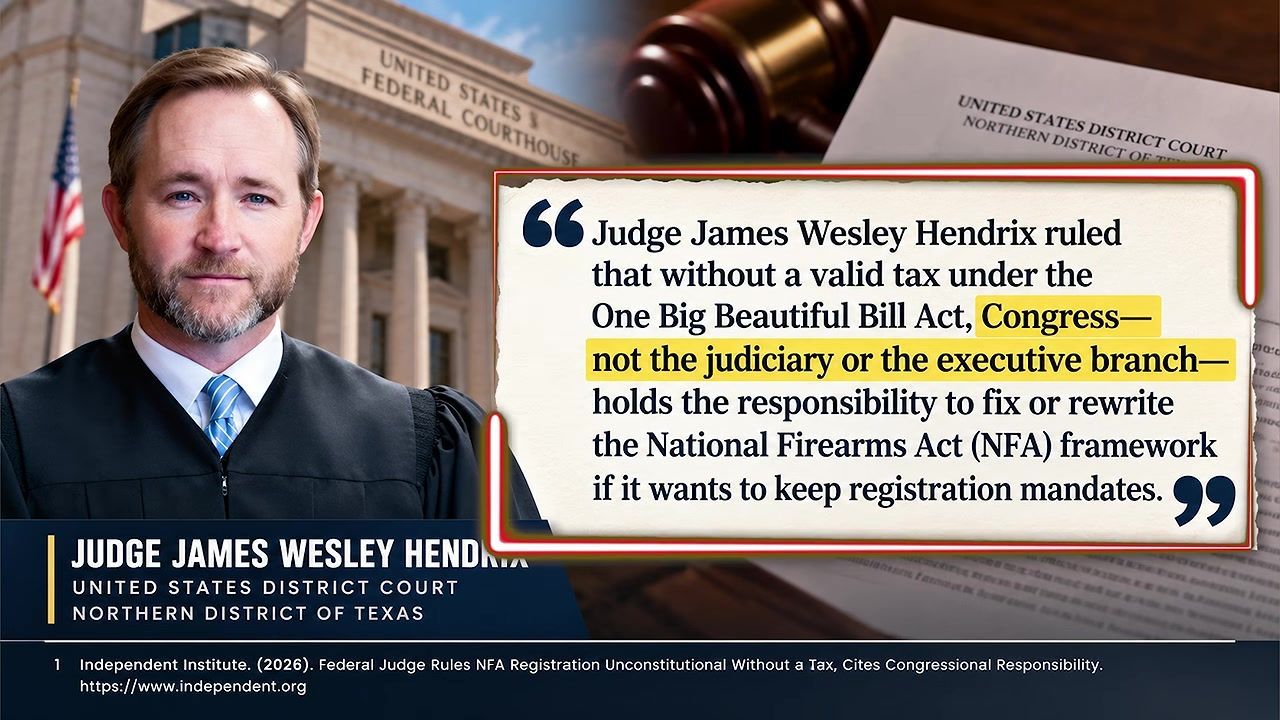
Which is exactly what somebody was about to argue in court. On August 5th, Judge James Wesley Hendricks in Federal Court in the Northern District of Texas ruled that without the tax, the government had no constitutional power to keep forcing registration on these items. And he was pretty clear about whose job it is to fix that. He wrote that it must come from Congress, not this court.
The Justice Department didn't appeal. That window closed October 5th. Then on October 9th, the ATF put out an open letter and basically said, we're not just going to stop enforcing this against the people who sued us, we're stopping for everybody nationwide. For suppressors, short-barreled rifles and shotguns, and AOWs, that means no ATF approval before you buy or build one. No federal registry, no tax stamp, and no marking requirement. A few years back, these approvals could take months, sometimes over a year. Now, to be fair, the electronic forms did get a lot faster. But now in a state that allows it, buying a suppressor looks a lot like buying a regular rifle at the counter, at least for now.
Same Suppressor, Different Answer: WA, OR, Montana
Idaho: Constitutional Protections and What Changed for Residents
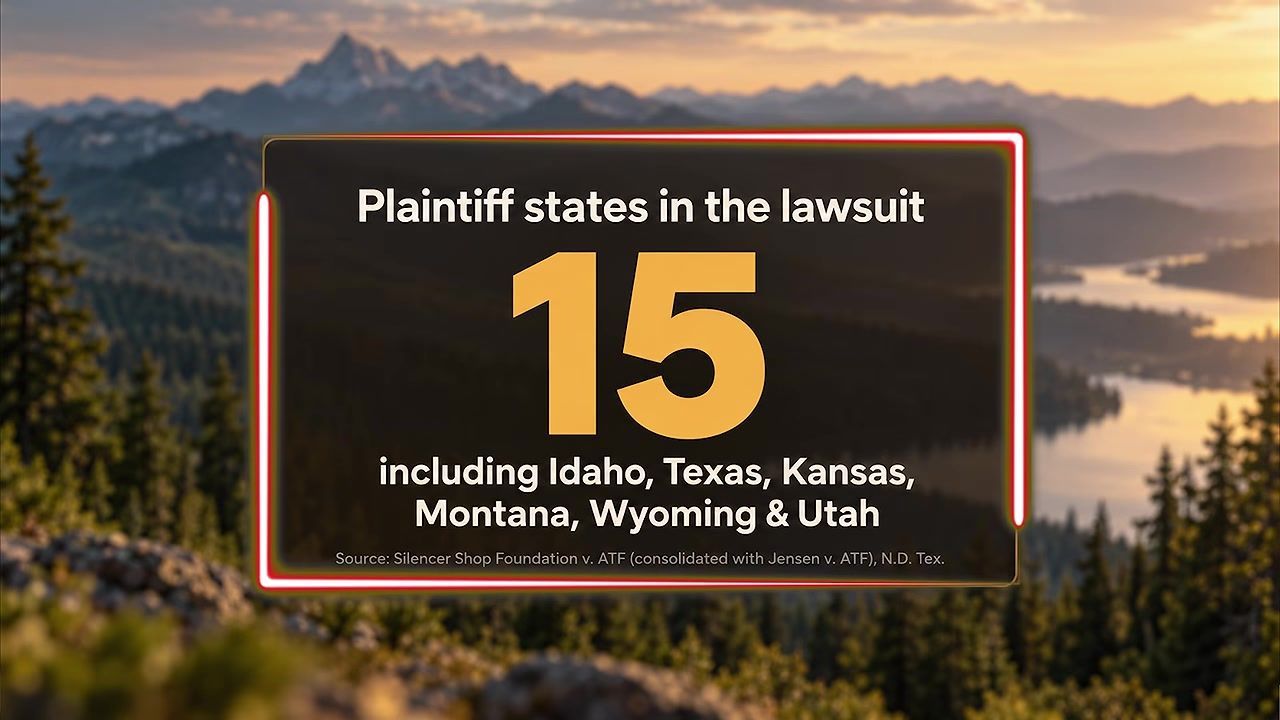
Idaho didn't just get handed this. It helped make it happen. Fifteen states signed on as plaintiffs right alongside the gun groups: Texas, Kansas, Montana, Wyoming, Utah, and Idaho, to name a few. Idaho's Attorney General Raul Labrador announced that Idahoans can now buy suppressors, short-barreled rifles, and short-barreled shotguns without registration, long waits, or federal taxes.
You'll see some headlines calling it an Idaho-led win, Kansas is calling it a Kansas-led win. So you have 15 states and somehow you got 15 leaders who led this. I don't know. Here's what actually matters for you though.
Idaho's own Constitution, Article 1, Section 11 , says no law shall impose licensure, registration, or special taxation on the ownership or possession of firearms or ammunition. Translation: Idaho can't turn around and build its own registry to replace the federal one. Idaho law also doesn't hang the legality of a suppressor or short-barreled rifle on the federal paperwork. So when the feds stepped back, there was nothing on the Idaho side still holding the door shut.
If you're in Idaho, this change actually reaches you. The constitutional protection means the state can't create a new hurdle to replace the federal one that just fell. And because Idaho law doesn't tie suppressor or SBR legality to federal registration, there's no gap left to trip over. You still pay Idaho's 6% sales tax at the register, and you still go through the same Form 4473 and background check as any other gun purchase. But the months-long federal approval process, the registry, the tax stamp? Gone.
This is one of those moments where Idaho's constitutional protections for gun rights actually show up in real life. It's not just rhetoric. It's the reason this federal change benefits Idaho residents while leaving people in other states stuck in legal limbo.
If you're reading this because Idaho has been on your radar and you like what you're hearing and want to look at moving here, reach out to us. We help people like you get moved to Idaho every single day and avoid making some of the costly mistakes that can sometimes accompany changing states.
Washington: When Federal Changes Don't Reach You
Washington is a totally different story. About 15 states still have laws that tie suppressor or short-barreled rifle legality to the exact federal paperwork the ATF just stopped enforcing. Washington is on that list.
In Washington, a short-barreled rifle is only legal if you're in compliance with applicable federal law. Short-barreled shotguns are banned for most people, period. So here's the problem: Washington state law says you need to comply with federal law. Federal law still says these items require registration. The ATF just stopped enforcing that requirement. But the law didn't change. The enforcement did.
And here's the kicker. The ATF itself says, I can't tell you whether an unregistered item counts as lawful under your state's law. It's not gonna touch that one. So if you're in Washington, the same suppressor that an Idaho resident can buy at the counter without federal paperwork is still legally murky for you. The federal government stopped asking for the paperwork, but your state law still points to that paperwork as the thing that makes it legal.
Nothing has changed for Washington residents yet. Same can, same day, and a completely different answer depending on which side of a state line you're standing on. Until Washington changes its own law to decouple suppressor and SBR legality from federal registration requirements, this federal policy shift doesn't help you.
Oregon: The Felony That Federal Paperwork Can't Fix Anymore
Oregon's situation is even tighter. In Oregon, possessing a suppressor or a short-barreled rifle is a Class B felony . Your defense is that it's registered as required under federal law. So in Oregon, the paperwork the federal government doesn't even want anymore is still the thing standing between you and a felony.
Let that sink in. The ATF stopped enforcing the registration requirement. But Oregon law says possessing an unregistered suppressor or SBR is a felony, and the only legal defense is federal registration. The federal government isn't asking for it anymore, but Oregon still is. And the ATF won't tell you whether an unregistered item satisfies Oregon's law. That's not their call.
So if you're in Oregon, this federal change has not reached you. The same suppressor that's now a straightforward purchase in Idaho is still a felony risk in Oregon unless you can point to federal paperwork that the federal government itself no longer requires. Until Oregon changes its own law, you're stuck in a legal gap where the defense you need doesn't exist anymore.
This is one of those situations where federal and state law are supposed to work together, and instead they're just pointing at each other. The federal side stepped back, and the state side didn't move. And you're the one left holding the bag.
Montana: Winning the Lawsuit but Still Enforcing the Old Rules
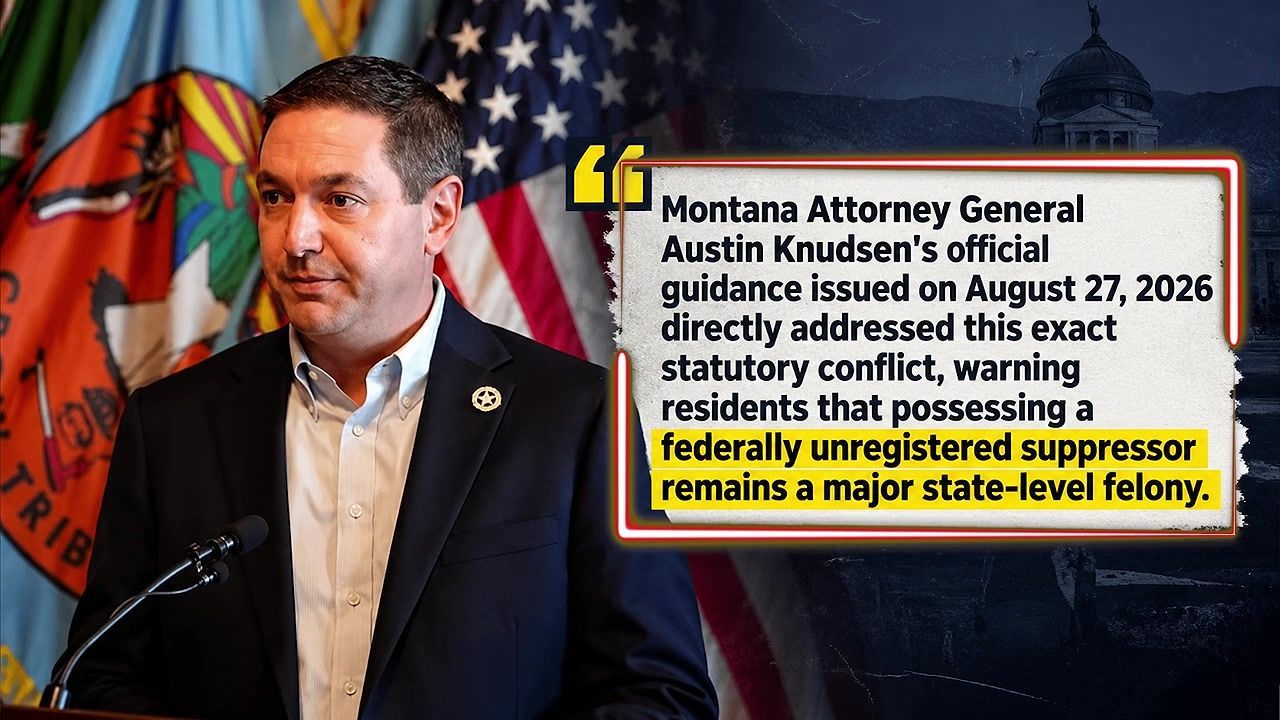
Montana was one of the 15 states that sued and won. Then Montana's own attorney general put out guidance this summer, and credit to him for being straight with people, saying that under Montana law, possessing an unregistered suppressor is still a felony, 5 to 30 years.
There's a bill lined up to fix it in their 2027 session, so hopefully they'll get that one figured out. But for now, if you live in Montana, nothing has changed for you yet. You're in the same boat as Washington and Oregon: a state law that still ties legality to federal paperwork that the ATF stopped enforcing.
The irony is thick. Montana was in the courtroom. Montana won. And Montana residents still can't benefit from the win until the state legislature changes Montana's own law. It's a reminder that federal changes don't automatically flow down to the state level. Sometimes the state is the last gate standing.
What Did NOT Change
Here's the part the headlines keep skipping: what did not change. Buying one of these from a dealer still means the same Form 4473 and the same background check as any other gun. Prohibited people are, of course, still prohibited, probably for a good reason, and the dealer still keeps records. The background check is still very much so on the clock.
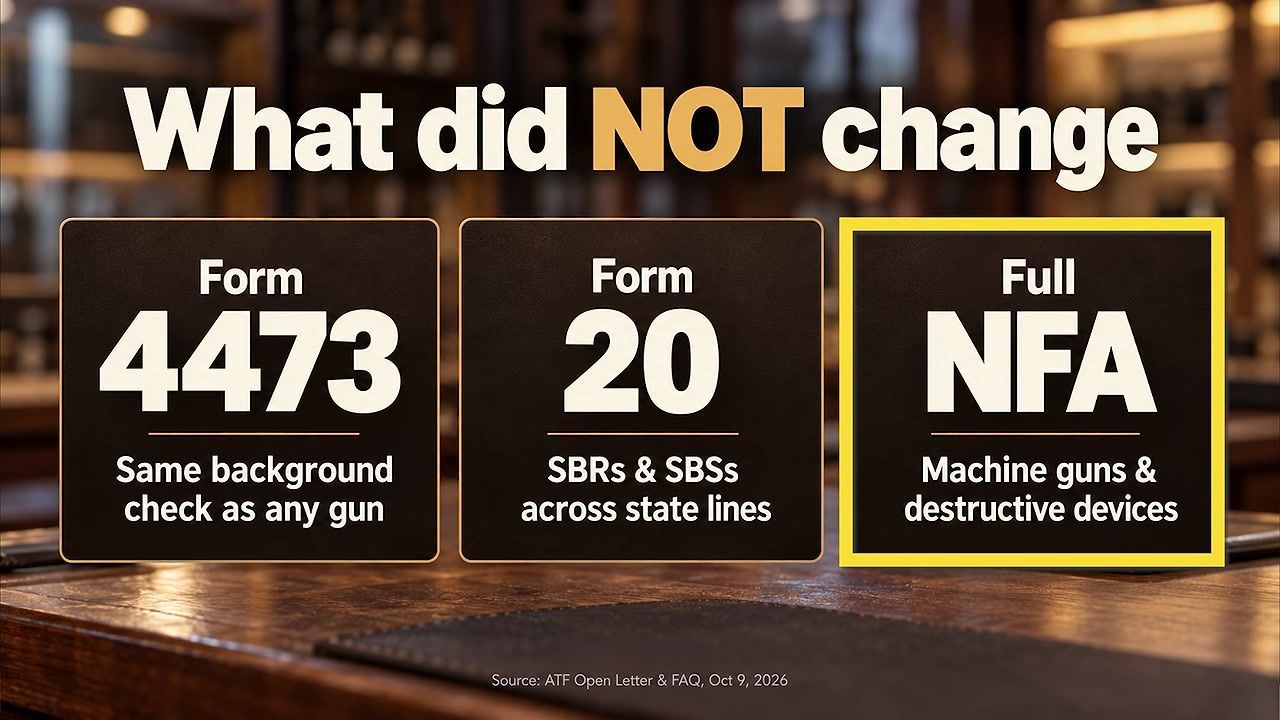
Short-barreled rifles and shotguns have their own wrinkle. A separate federal law, the Gun Control Act, says you need ATF approval before you take one across state lines. That's the Form 20 , and it's still required, registered or not. So your SBR can skip the line to come home with you, but it still needs a permission slip to go on vacation.
There's also a separate rule that a dealer needs federal approval to sell you a short-barreled rifle or shotgun. The ATF says it's not enforcing that one for now while it drafts new forms and regulations for it, which tells you some kind of new approval process is coming. Of course it is.
And machine guns and destructive devices? They're untouched. Full NFA and still a $200 tax. State and local laws still apply everywhere, and the federal tax may be zero, but Idaho's 6% sales tax at the register didn't go anywhere. Similar to HPV, some taxes never go away.
So buying a suppressor in Idaho now looks like this: walk into a dealer, fill out Form 4473, pass the background check, pay the sales tax, and take it home. No months-long wait for federal approval. No tax stamp. No registry. But you're still going through the same dealer process and background check as any other firearm. And if you want to take your short-barreled rifle on a road trip, you still need to file Form 20 before you cross state lines.
The Catch: This Is Policy, Not Repeal
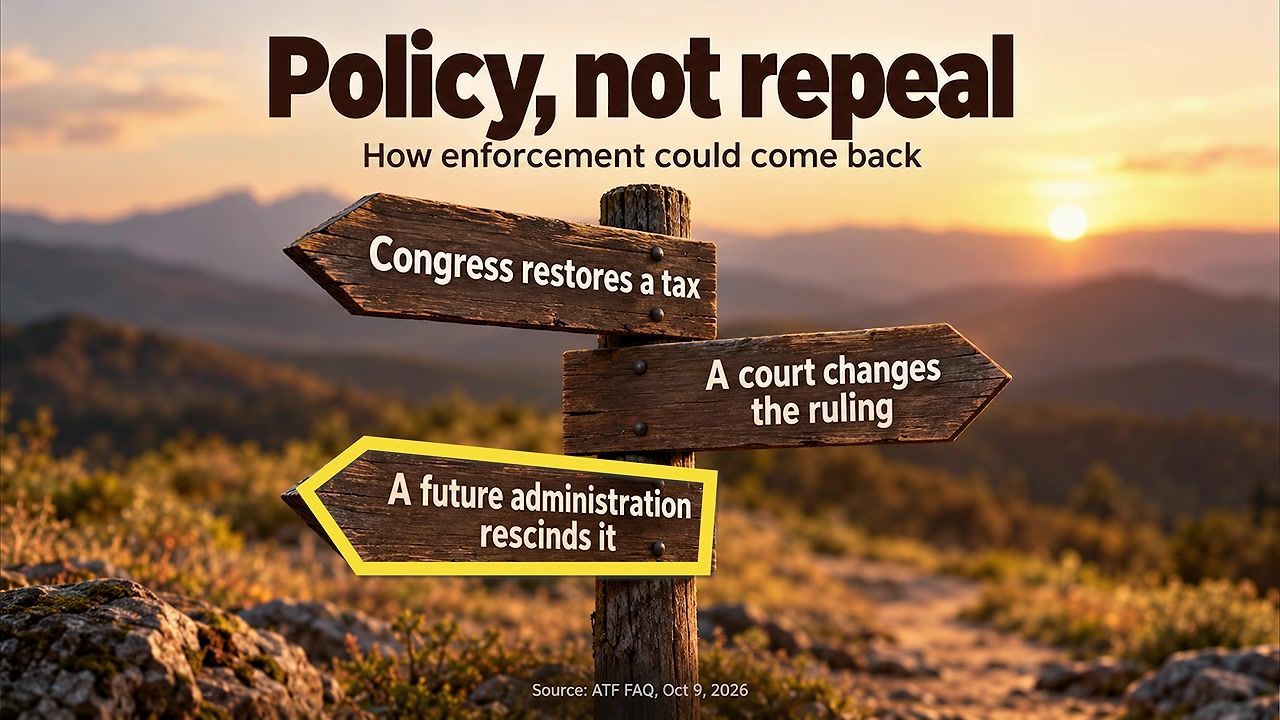
Now the catch, and this is the part I care about most because it's the part that could make somebody a felon later. This is not a repeal. The National Firearms Act is still the law. Every word of it is still on the books. What changed is enforcement. It's a decision by this Justice Department not to enforce, and a decision can be undecisioned or undecided if you want to be proper about it.
Even the ATF's own FAQ says enforcement could come back if the legal or factual situation changes. Congress could put a tax back on, a court could change the ruling, or a future administration could just rescind the policy. That's the ATF saying it, not me.
So why does this matter? Under federal law, an unregistered NFA item is contraband with felony penalties, and the ATF says federal law generally doesn't let you register one after the fact. And there's no automatic grandfathering. The only way back would be an amnesty, and that's up to the Attorney General, not you.
An enforcement policy is basically a promise from whoever's running things right now, and whoever's running things right now has a lease, not a deed. The good news: you can still register voluntarily. The ATF is still running the registry and still processing the forms. And if you already have registered items, the ATF warns that once something comes off the registry, it can't go back on without an amnesty. So don't start unregistering stuff because it feels like a victory lap. We're not there yet.
Back in September, Attorney General Labrador and 20 other attorney generals asked Congress to make this permanent and repeal those provisions for good, because a policy can be reversed with a signature. A law takes Congress. The paperwork is gone. The law that created it isn't. Know which one you're standing on.
Conclusion
So who decides whether you register? You do. That's the whole point. Just decide with your eyes wide open. Read the ATF FAQ. Even Idaho's attorney general is telling people to read it before they buy. And if you've got real questions, please talk to an attorney.
If you're in Idaho, this change is real and it's reaching you right now. If you're in Washington, Oregon, or Montana, you're waiting on your state to catch up. And if you're seriously looking at moving to Idaho because you like what you're hearing about gun rights protections that actually show up in real life, reach out to us at 208-907-5757 or email me at Trent@livingliferealtygroup.com to schedule a time to talk with me or my team. We help people relocate to Idaho every single day and avoid some of the major pitfalls that can come with changing states.
FAQ
What exactly did the ATF stop enforcing on October 9th?
The ATF stopped enforcing NFA registration, approval, and tax-stamp requirements for suppressors, short-barreled rifles, short-barreled shotguns, and any other weapons. You still go through Form 4473 and a background check when buying from a dealer, but the months-long federal approval process and registry are gone.
Why did Congress cut the NFA tax to zero?
The One Big Beautiful Bill originally tried to remove suppressors from the NFA completely, but the Senate parliamentarian struck that out. So Congress cut the tax on suppressors, SBRs, SBSs, and AOWs to zero starting January 1st, 2026. Once the tax was gone, a federal court ruled the government had no constitutional power to keep forcing registration.
Does this change apply to machine guns?
No. Machine guns and destructive devices are untouched. Full NFA rules still apply, including the $200 tax.
Can I take my short-barreled rifle across state lines now?
You still need ATF approval before you take an SBR or SBS across state lines. That's Form 20, and it's still required, registered or not. A separate federal law, the Gun Control Act, requires that approval.
Why doesn't this change help Washington and Oregon residents?
About 15 states, including Washington and Oregon, have laws that tie suppressor or SBR legality to federal registration. In Oregon, possessing an unregistered suppressor is a Class B felony, and your only legal defense is federal registration that the ATF no longer requires. In Washington, SBRs are only legal if you're in compliance with federal law, which still says registration is required even though the ATF stopped enforcing it. Until those states change their own laws, the federal policy shift doesn't reach residents there.
Could the ATF start enforcing NFA registration again?
Yes. This is an enforcement policy, not a repeal. The National Firearms Act is still the law. The ATF's own FAQ says enforcement could come back if the legal or factual situation changes. Congress could put a tax back on, a court could change the ruling, or a future administration could rescind the policy. An unregistered NFA item is still contraband under federal law, and there's no automatic grandfathering or way to register after the fact without an amnesty.
Recent Posts