

Should You Buy a Home in Idaho Now or Wait a Year?
I worked with a buyer last year who almost pulled the trigger on a $550,000 house. The rate was sitting around 6.3%, and the numbers were tight, but they worked. Then he did what basically everybody does: he thought he'd just wait for rates to drop a little bit more.
Great plan. Let's see how that's going.
A year later, that same house isn't $550,000 anymore. And the rate he was holding out for? It didn't drop. We're going to get into exactly what that decision cost him before this is over, but first you need to understand what's actually happening in this market right now. Because it's probably not what you think.
As of today, the 30-year mortgage rate we're working with is right around 7.19%. Not 6%, not coming down soon. The Fed just raised its short-term rate again this week, and the bond market reacted. Mortgage rates don't move one for one with the Fed, and the Fed doesn't sit in a room and set your 30-year rate directly. But the message from both of them right now is the same: money is not getting cheaper on command. Everybody who spent the last two years waiting for rates to come back just watched them go the other direction again.
Every few months, Fannie Mae puts out another forecast about where rates are headed. And every few months, the forecast gets quietly revised to match whatever rates actually did. At this point, that's not forecasting. That's a weather app telling you it's raining after you're already wet.
Table of Contents
Kootenai County: Up 8% While Washington Falls
Here's a question for you: why do home prices in Idaho keep going up while 30 minutes away across the state line in Washington, they're actually falling? Same region, same interest rate environment, same everything basically. And somehow one state's going up and the other one's coming down.
Washington State median home price is down 2.8% over the last year and homes for sale are up over 15%. That's technically a buyer's market, more homes, lower prices, except sales fell too. So buyer's market, but the buyers are sold separately.
Idaho, same time period, same data source, so we're comparing apples to apples: home prices are up nearly 8% and the number of homes for sale actually went down over 16%. While Washington's getting more inventory and lower prices, Idaho is getting less inventory and higher prices. Same year, same interest rate environment, completely opposite directions.
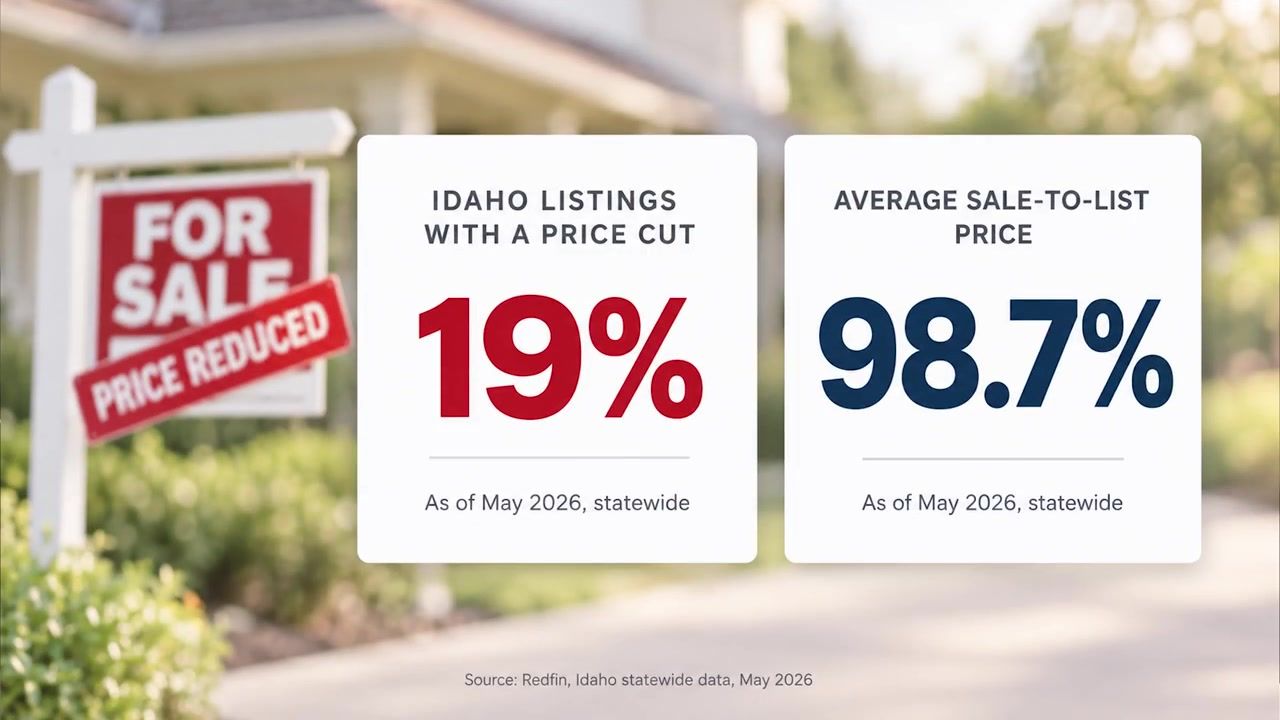
And here's something buyers miss when they hear prices are still climbing statewide: that does not mean every single seller is getting whatever they want. Here in Kootenai County specifically, a meaningful share of listings have already taken a price cut, and homes that do sell are landing right around asking, not above it. The market can be appreciating overall while an individual seller is still very negotiable. Those are two different things.
So the move right now isn't waiting for the whole North Idaho market to cool off. It's finding the one seller who already has.
Look, I want to be fair here because it isn't Washington bad, Idaho good. That's not the point. Oregon's doing a quieter version of the same thing, prices down a little, sales down a little, nothing dramatic. California statewide is basically flat. It's specific coastal metros that are really feeling it, not entire states collapsing. So let's not pretend the whole West Coast is on fire because it's not.
But the direction of travel? Coastal markets are cooling and Idaho is not. Idaho's still got people moving in, still got limited supply, and the coast is dealing with more inventory and cooling demand.
Is This Pace Sustainable?
Which brings up the bigger, more uncomfortable question: is this sustainable? Because nothing goes up forever. And if you've ever been in Idaho for more than five minutes, you've heard somebody say this can't keep going about literally every single year since 2016. And yet here we are.
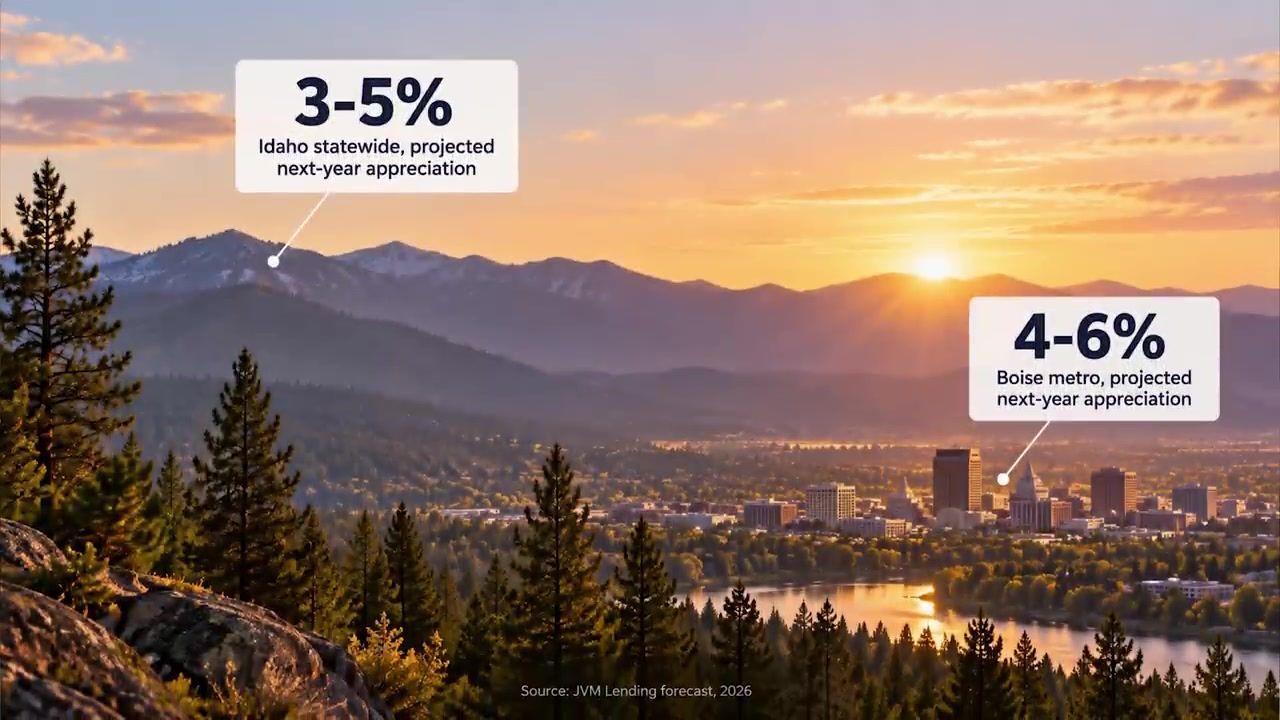
So let's actually look at what the forecast says instead of vibes. Idaho is projected to keep appreciating somewhere in the 3 to 5% range statewide over the next year, with the Boise metro running a little hotter, 4 to 6%. Three to five percent is your house putting on khakis, clocking in and doing its job. That's not 2021. That's just a functioning housing market.
But I want to be clear about something here too. None of this means you should buy a house you cannot comfortably afford because you're scared prices might go up. The payment has to work today. If the only reason the house makes sense is because you're convinced rates will drop next year and you'll refinance, that's not a plan. That's another forecast. And we just talked about how those have been going.
Meanwhile, the rate side of this isn't getting better either. It was supposed to happen this year. Then it got pushed to next year. At some point, you have to stop building decisions around what somebody thinks might happen 12 months from now and start looking at what's actually happening today. And today, rates went up, not down.
So here's the honest answer to is this sustainable: probably not forever. Nothing is. But there's a real difference between this specific pace might eventually slow and you should wait around for it to reverse. Waiting for Idaho appreciation to stop is a bet, and waiting for coastal rates to drop back to 3% is not a bet. It's a fantasy. You're allowed to plan your life around a calculated risk. You probably shouldn't plan it around a fantasy.
Spokane vs. Kootenai County: Same Drive, Opposite Market
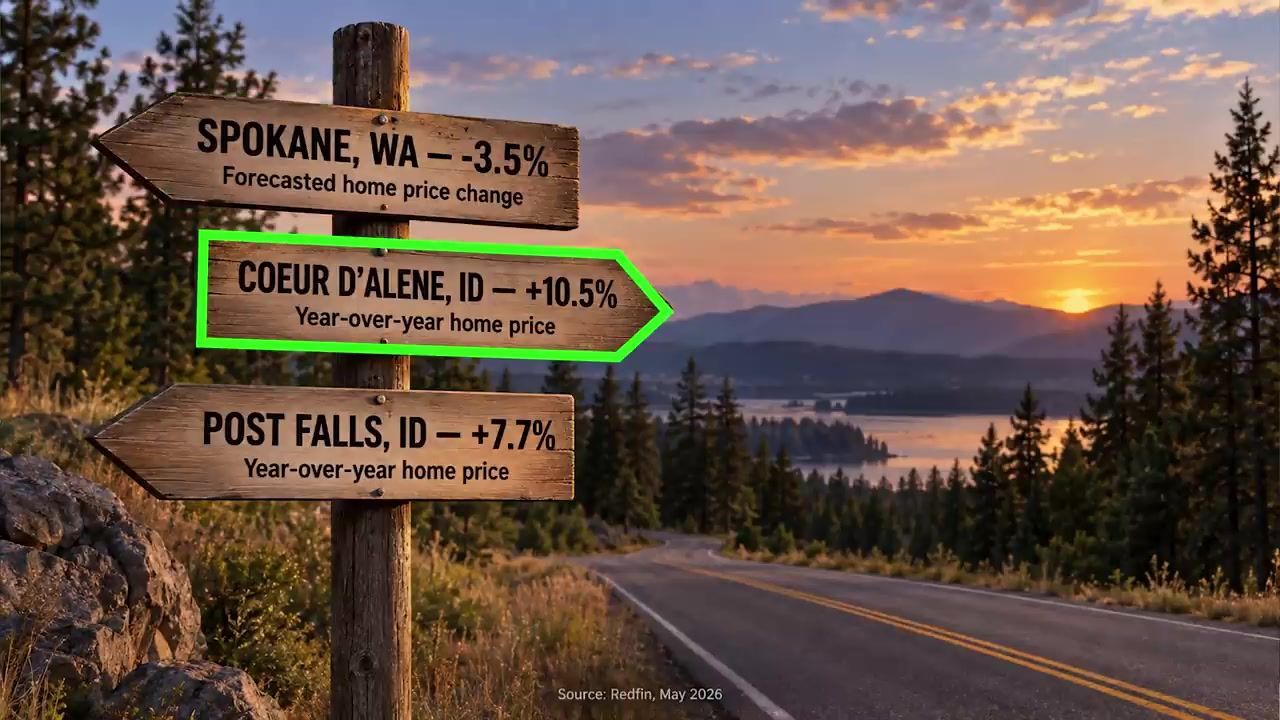
You don't have to take my word for it because you can watch it happen in real time. About 20 minutes from where I'm standing, Spokane, Washington is forecasted to drop another 3.5%. Coeur d'Alene is up 10.5%. Post Falls up almost 8%. Rathdrum up over 12%. Hayden almost 14%.
Drive 15 minutes from Spokane to Kootenai County, and without doing anything differently, your home value flips from shrinking to growing. There really should be a sign at the state line saying, welcome to Idaho, please adjust your net worth accordingly.
What Waiting One Year Actually Cost
Which brings us back to the guy from the beginning of this video, because he's not a hypothetical. He's living exactly what we just talked about. Everybody's afraid of being the guy who buys at the wrong time. He was so careful he managed to rent at the wrong time instead.
A year ago, that house was $550,000. The interest rate was 6.3%, and he waited. Here's the bill for that decision.
Twelve months of rent at $4,000. That's $48,000 towards a house, just not his house. That same house today isn't $550,000 anymore. Idaho appreciation puts it closer to $593,000. And the rate he was holding out for? It's not lower. It's 7.19%. Worse rate, bigger loan, same house.
Add it all up and I'll just wait has put him somewhere north of $91,000 behind where this decision started. That's not a rounding error. That's most of a second down payment gone, and he still doesn't own the house.
And that's just the cash side. Look at what happened to the actual payment. We're using 10% down for this example. Some loan programs go a lot lower, FHA can be 3.5%, and VA can be zero for eligible veterans.
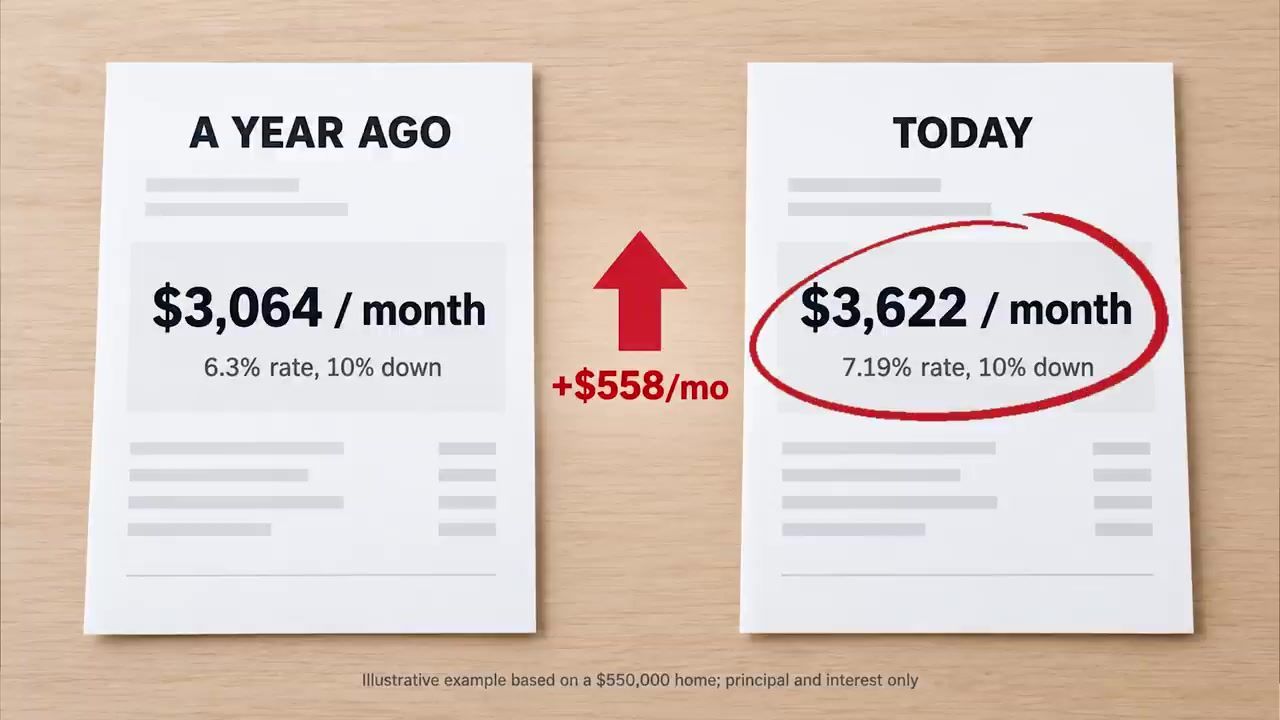
A year ago, 10% down on that $550,000 house puts him at a $495,000 loan at 6.3%. About $3,064 a month. Today, same 10% down on a house that's now worth $593,000 at 7.19%? About $3,622 a month. And that's just principal and interest. I want to be clear about that.
$558 more every single month. That's basically another car payment, except this one doesn't come with a car. Run that out over the life of the loan and waiting one year quietly adds around $200,000 to what he'll ultimately pay for this house. He didn't buy anything with that extra $200 grand. He basically financed the year that he waited.
And here's the part that should really bother you: what happens if he does this again? If he waits one more year hoping something changes and Idaho keeps appreciating at even a modest 4%, that same house is pushing $617,000. Another 12 months of rent is another $48,000. Run it forward and I'll wait one more year turns into roughly $160,000 gone. For a house that hasn't gotten one bit better. Same house, same kitchen. Apparently the house just got a raise.
So this isn't one of those don't wait, trust me videos where I just say the sentence and move on. That's a bumper sticker, not an argument. This is the actual math laid out for a guy who's living it right now, still paying $4,000 a month for the privilege of owning nothing.
The Three Questions Before You Buy
So what do you actually do with this? Because the answer isn't everybody needs to buy a house immediately. It's not. Forget trying to predict next year's rate for a second. If you're thinking about buying, ask yourself three questions.
One, can I comfortably afford the payment today? Not after some theoretical refinance. Today.
Two, am I likely to own this house long enough that short-term market movement doesn't control the decision?
And three, is this actually the right property for my life? Not is this the lowest rate I might ever see. Not can I perfectly time the bottom. Is the house right and does the math work?
If those three answers are yes, now we can start negotiating the deal instead of trying to predict the economy. And remember what I showed you earlier? Appreciation doesn't mean you have zero leverage. There are sellers right here in Kootenai County who've already cut their price. So instead of waiting for the whole North Idaho market to get cheaper, maybe we just find the one seller who already decided theirs needs to be.
Ready to Run Your Numbers?
If you're sitting where he was a year ago, the numbers are tight, but they work, and you're tempted to wait for something better, the data says better is not coming. Not on rates, not on Idaho prices.
And if you're on the coast right now watching your home's value soften and wondering if staying put is automatically safer, it isn't. Run your own numbers.
If you're already here and already looking and already doing the math in your head, that's exactly what we just did. Give us a call and we will run your numbers specifically to see what really makes sense for you. We genuinely love to help you figure out your own version of this before it turns into somebody else's cautionary tale on a video like this one.
FAQ
Should I wait for mortgage rates to drop before buying in North Idaho?
Rates were supposed to drop this year, then got pushed to next year. As of this week, they're sitting around 7.19% and went up, not down. At some point, you have to stop building decisions around what somebody thinks might happen 12 months from now and start looking at what's actually happening today.
Are North Idaho home prices still going up?
Yes. Kootenai County home prices are up nearly 8% year-over-year while inventory is down over 16%. Coeur d'Alene is forecasted up 10.5%, Post Falls up 8%, Rathdrum up 12%, and Hayden up 14%. Statewide, Idaho is projected to keep appreciating somewhere in the 3 to 5% range over the next year.
Can I still negotiate in an appreciating market?
Absolutely. The market can be appreciating overall while an individual seller is still very negotiable. A meaningful share of listings in Kootenai County have already taken a price cut, and homes that do sell are landing right around asking, not above it. The move right now is finding the one seller who's already decided their price needs to come down.
Why is Idaho going up while Washington is going down?
Idaho still has people moving in with limited supply. Washington State median home price is down 2.8% with inventory up over 15%. Spokane is forecasted to drop another 3.5% while Kootenai County communities are rising 8 to 14%. Drive 15 minutes from Spokane to Kootenai County and your home value trajectory flips from shrinking to growing.
How much does waiting one year actually cost?
Using a real example: a $550,000 house a year ago is now $593,000. The buyer paid $48,000 in rent, lost $43,000 to appreciation, and now faces a monthly payment that's $558 higher due to both the price increase and rates going from 6.3% to 7.19%. That's over $91,000 behind where the decision started, and he still doesn't own the house.
What questions should I ask before buying?
Three questions: Can I comfortably afford the payment today, not after some theoretical refinance? Am I likely to own this house long enough that short-term market movement doesn't control the decision? Is this actually the right property for my life? If those three answers are yes, now we can start negotiating the deal instead of trying to predict the economy.