

The Idaho Land That'll Bankrupt You: 5 Traps Nobody Warns You About

Everybody wants a piece of Idaho right now. Room to breathe, trees, mountains, a piece of dirt that's actually yours. No neighbor 12 feet off your bedroom window. That's the dream, and I get it.

But here's what nobody selling you that dream says out loud: in Idaho, the deed you sign doesn't mean what you think it means. You think you're buying the land. What you're actually buying, if you're not careful, is a very expensive place to set up your tent.

I've had people call me after the fact. Good people, cash in hand, ready to build their dream home. They found out too late they couldn't drink the water, couldn't legally drive to their own property, or couldn't build a single thing on it. Nobody warned them because the guy selling it doesn't get paid to warn you. I do. Well, not for this video, but you get the idea.

In this article, I'm walking through the 5 traps, 5 ways the land you bought isn't actually yours to use. I'm doing them in order because trap 5 quietly bankrupts the most people, but trap 1 is the one that's going to make you the angriest. It's the one that makes the least sense.

Table of Contents

Trap 1: You Own the Creek, Not the Water

This is the one that makes people from out of state genuinely angry, so buckle up.

In most states, you buy land with a creek running through it and that water is basically yours. It's called riparian rights. Makes sense. It's your dirt, it's your water. But Idaho looked at that idea and said, nope, we're not gonna do it like that.

In Idaho, water is a public resource. It's owned by the state, not by you, not by the guy upstream, not by anybody whose land it happens to run across. The system is called prior appropriation: first in time, first in right. Whoever got there first and put the water to use has the senior claim, and everybody else gets in line behind them.

Here's the part that'll get you: you can own both banks of a creek, you can watch it run through your property 365 days a year, and you can have zero legal right to retain it.

The Domestic Well Exemption

I'm not going to leave you standing there thirsty. There's one thing you can do without asking anybody. It's called the domestic well exemption. You drill a well, you can use up to 13,000 gallons a day for your house, your livestock, and watering up to half an acre. No permit, no water right.

But if you want to irrigate more than half an acre, now you need a real permitted water right with a priority date and a spot in line. Half an acre of lawn is plenty for most people, by the way, unless you were planning to open your own golf course, in which case that's a different video I haven't made yet.

The 436-Foot Dry Well

Let me tell you about a guy who called me a few years back. He had bought 10 acres in North Idaho. Paid a pretty penny for it too. Real pretty. And when he went to drill his well, he drilled and drilled and drilled. 436 feet down. No water.

The neighboring parcel right next door hit water at 220 feet. This is kind of an anomaly. This is very rare to happen, but it happened to him.

So now he's got a decision that nobody should have to make: keep drilling, keep spending tens of thousands of dollars chasing water he might never hit, or cut his losses and walk away from the land entirely. He chose to walk, and you'd think that's where the pain stops, but it's not.

A dry well is what Idaho calls an adverse material fact. When he went to sell that land, he legally had to disclose it, which tanked the value. So add it all up: he lost money he sank into a well that never hit water, then he lost again on the sale because now every buyer knows that the well is really deep if he can even get to water. All in, about $100,000 gone in under a year on land that looked absolutely perfect in the photos.

Nobody can eyeball 400 feet of dry rock from a listing. That's trap 1. The water you can see isn't yours, and the water you can't see might not even be there.

Trap 2: Landlocked Parcels and Access Rights

There is a road to the property. Of course there is. You drove it to look at the place, felt pretty solved. But here's the problem: a road physically reaching your land does not mean you have the legal right to use it.

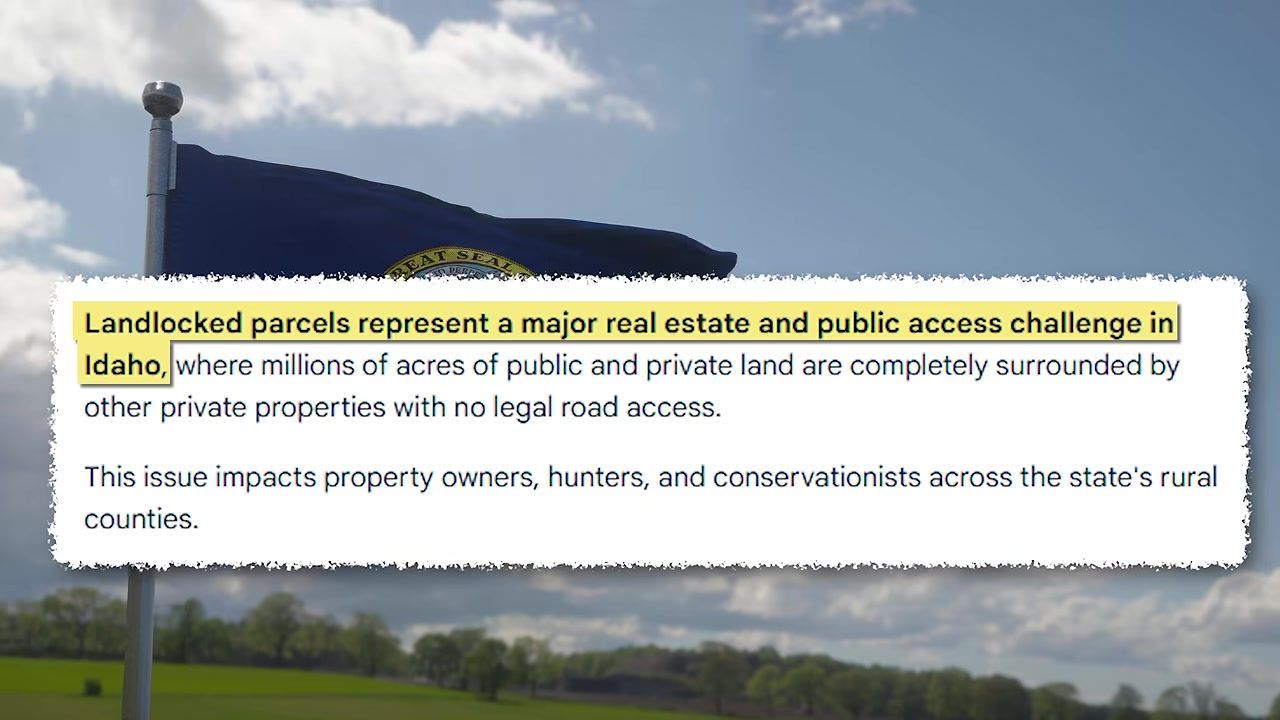
Landlocked parcels are all over Idaho, especially out in the remote counties. Here's how people get got. The seller says, oh yeah, everybody just uses the road across the neighbor's place. Always have. It's no problem. It's a handshake, a verbal deal, and we've always done it this way.

Legally, that's worth nothing.

Recorded Easements vs. Verbal Agreements

If it's not a recorded easement filed at the county attached to the deed, it does not transfer to you when you buy the property. The old owner's friendly arrangement with the neighbor is not your arrangement. And when the neighbor decides he doesn't like your dog or your fence or your face, your remedy is to file a lawsuit in county court for something called an easement by necessity, where you have to prove you're truly landlocked with no other way in.

Thinking you'll just lean on, well, people have driven that road for years? That's a prescriptive easement, and now it takes 20 years of open, continuous, and adverse use to establish, meaning there never was permission given to anybody to use that road. So for 20 years, you have to just be doing it. And it used to be 5 years. They changed it in 2006.

Nothing says living the dream quite like suing your brand new neighbor before you finished unpacking the truck.

Trap 3: When the Ground Fails the Perc Test

The land's cheap because, hey, it's just land, right? You'll build later. Careful with that assumption.

Idaho raw land doesn't come with the disclosure form. A house does. When you buy an existing home, the seller fills out a condition disclosure. Bare land? There is no such form. The job of finding out what's wrong with it is 100% on you or the agent you're working with, but you should both be checking.

The Septic Permit Requirement

The big one is the perc test. Rural parcels means no city sewer, which means you're putting in a septic system, which means the ground itself has to pass a test.

Every subsurface septic system in Idaho needs a permit. Up here in the 5 northern counties, that's the Panhandle Health District, and they can deny it flat out if the soil, groundwater, or the slope don't cooperate. No perc, no septic. No septic, no house. Congratulations, you now own the most expensive campsite in Kootenai County.

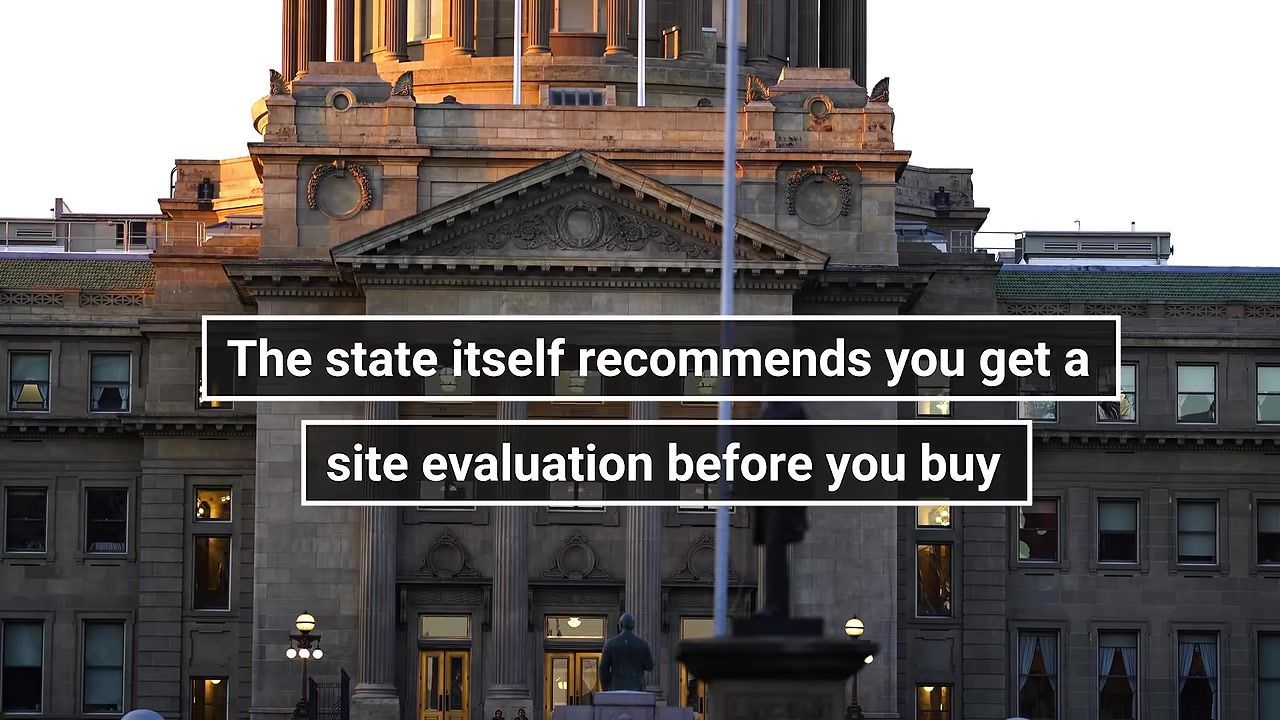
You want to know how serious this is? The state itself recommends you get a site evaluation before you buy. Read that again, or listen to that again. The government, not exactly famous for being helpful, is telling you to test the dirt before you sign, and people still skip it because the drone footage looked amazing.

Put It in the Offer

So do this instead: put a perc test contingency in your offer. The test passes, you move forward. If the test fails, you walk or you renegotiate. That is free advice, and it's worth more than all the Costco hot dogs you could eat in a year. Probably a lot more, actually.

Trap 3: some land legally cannot have a house, and the only way to know is to test it, not trust it.

Trap 4: Wildfire Insurance and the Uninsurable Parcel

Say the water's there, the road's recorded, the soil passes. You're in the clear now, right? Oh, you sweet summer child.

Sometimes cheap land is not a deal. It's a warning that the insurance market already saw coming and priced in. I'm talking about wildfire risk zones, and this stopped being theoretical a while ago.

The Non-Renewal Crisis

Idaho homeowner insurance non-renewals (that's the company deciding not to renew your policy) jumped from around 3,900 in 2022 to nearly 28,000 the very next year. 1 year. And it lands harder in some spots than others. Boise County ranked 87th in the entire country for the highest non-renewal rates out of every county in America.

Here's the kicker most people moving here have no idea about as well. This is going to hurt. Idaho has no FAIR plan. A lot of states have one. It's the insurer of last resort, the government backstop that covers you when the private companies won't. Idaho doesn't have it.

So you get dropped and there's no net under you. You're just uninsured on a mortgage, which your lender will absolutely not allow.

What You Can Control

It's not hopeless though. Defensible space around the house, fire-resistant roofing, ember-resistant vents: that stuff genuinely affects whether the insurer will keep writing your policy. But you check the wildfire risk for that specific address before you buy, not after the non-renewal letter shows up in the mailbox. That's a little too late.

I know, I know. But Trent, it's so beautiful up here. Yeah, it was a beautiful spot for everybody whose place is now an insurance claim too.

Trap 4: some land is cheap because staying insured on it is a part-time job. The sticker price is not the price.

Trap 5: The Freedom Parcel That Comes With Rules

You come to Idaho to get away from the HOA, the committee, the busybody with the tape measure and an opinion about your grass. So you buy your freedom acreage, and surprise, it comes with covenants and a shared road agreement. You drove 800 miles to escape the HOA and accidentally joined a smaller, angrier one.

The Road Maintenance Reality

Here's the road part, and it's a real one. Under Idaho code, the government can keep a public right-of-way open to the public without any obligation to actually maintain it. In snow country, that means the county might not plow it ever.

Private roads are maintained entirely at the owner's expense: grading, snow removal, drainage, gravel. Usually spelled out in a recorded road maintenance agreement. That's you and everybody else on the road splitting the bill, as well as the arguments. Mostly the arguments.

And if you're buying with a loan, here's the twist: your lender will very likely require a recorded road maintenance agreement before they'll close, because the bank knows land you can't reliably get to loses value very fast.

The Irony

So the exact thing you moved here to escape (a signed agreement binding you to your neighbors over shared property) the bank makes you sign it on the way in.

Trap 5: the freedom parcel can come with more rules than the cul-de-sac you left. You just don't find out until the first snow or the first bill.

Who This Actually Applies To

Let's add it all up. Water you might not be able to touch, a road you might not legally be able to drive on, soil that may not perc, a wildfire premium you may not be able to hold, and a plow bill you never signed up for. That's the gap between the dream and the deed, and every bit of it is invisible in the listing photos.

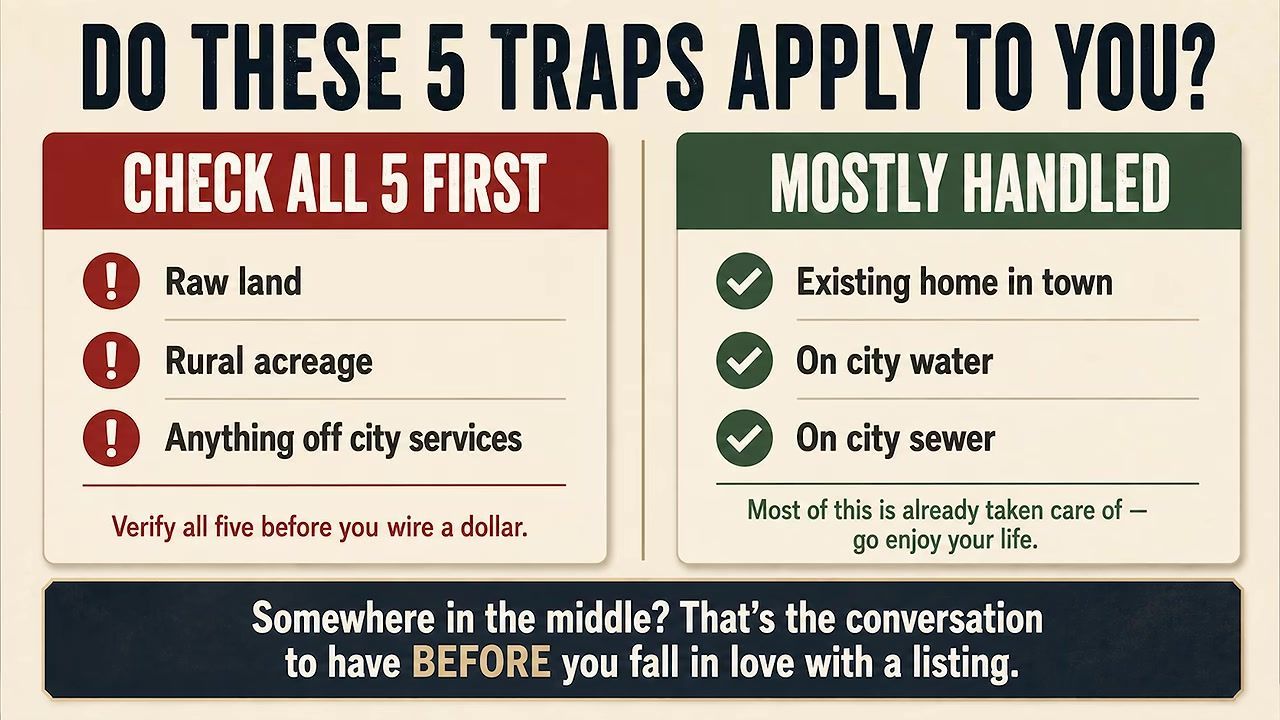
Here's who actually needs to worry about all of this: if you're buying raw land, rural acreage, anything off city services, every one of those 5 is live and you check all 5 before you wire a single dollar.

If you're buying an existing home in town on city water and sewer, most of this is already handled by them. So go enjoy your life.

Somewhere in the middle? That's exactly the conversation to have before you fall in love with a listing and definitely not after. That's the discussion you have to have.

Every one of these is checkable ahead of time if you know the ground or you know somebody who does. And guess what? We do.

Ready to Check Before You Buy?

Look, I'm not telling you this to scare you off from moving to Idaho. I moved up here on purpose. I'm telling you because every one of these traps is checkable before you spend a dime, if you know what you're looking at or you know somebody who does.

If you want the straight version before you buy, give us a call or shoot us a text at (208) 907-5757. Or shoot us an email at explore@livinglifenorthidaho.com. We will tell you what the listing description is not telling you.

We help people relocate to Idaho, Western Montana, and Eastern Washington every single week, and we make the process smooth, honest, and stress-free. Let's talk before you sign, not after.

FAQ

What are water rights in Idaho and why don't I automatically own the water on my land?

Idaho uses a prior appropriation system, meaning water is owned by the state, not by landowners. First in time, first in right. You can own both banks of a creek and have zero legal right to retain it. The domestic well exemption allows 13,000 gallons a day for your house, livestock, and up to half an acre of irrigation without a permit. Anything more requires a permitted water right with a priority date.

What happens if I buy landlocked property in Idaho?

If the property doesn't have a recorded easement filed at the county, you have no legal right to use the road, even if the seller says everybody's always used it. Verbal agreements don't transfer. Your remedy is to file a lawsuit for an easement by necessity or wait 20 years to establish a prescriptive easement through continuous use. Check for a recorded easement before you close.

What is a perc test and why does it matter?

A perc test determines if the soil can support a septic system. Rural parcels with no city sewer require a septic permit, and the Panhandle Health District (in the 5 northern counties) can deny it if the soil, groundwater, or slope don't pass. No perc, no septic. No septic, no house. Put a perc test contingency in your offer so you can walk if the land fails.

Can I get homeowner insurance on rural Idaho land?

It depends on the wildfire risk. Idaho homeowner insurance non-renewals jumped from 3,900 to 28,000 in one year. Boise County ranked 87th in the country for non-renewals. Idaho has no FAIR plan (insurer of last resort), so if you get dropped, you're uninsured. Defensible space and fire-resistant materials help, but check the wildfire risk for the specific address before you buy.

Do I have to pay for road maintenance on my private road?

Yes. Private roads are maintained entirely at the owner's expense, usually through a recorded road maintenance agreement. You and your neighbors split the cost of grading, snow removal, drainage, and gravel. If you're buying with a loan, your lender will likely require a recorded road maintenance agreement before closing. The county can keep a public right-of-way open without any obligation to maintain it.

Does raw land in Idaho come with a disclosure form?

No. When you buy an existing home, the seller fills out a condition disclosure. Bare land has no such form. The job of finding out what's wrong with it is 100% on you or the agent you're working with. The state recommends a site evaluation before you buy, and that's not a suggestion you ignore.

Living Life Realty Group

MOVING TO North Idaho

Guide titled "Living in North Idaho" over an aerial view of a city with a lake.

WATCH OUR VIDEOS

Share this article

Recent Posts

Here in Kootenai County specifically, a meaningful share of listings have already taken a price cut, and homes
By Trent Grandstaff • October 1, 2026
North Idaho home prices are up 8% while rates hit 7.19%. We break down what waiting actually costs buyers in Coeur d'Alene, Post Falls, and Kootenai County.

Then July hits and they're sitting in traffic in the town they moved to escape traffic.
By Trent Grandstaff • September 17, 2026
Thinking about moving to North Idaho? Compare Coeur d'Alene, Sandpoint, and Hayden for lifestyle, convenience, isolation, and real estate.
inside it can be as small as 1,500 square feet.
By Trent Grandstaff • August 27, 2026
See how Idaho’s 2026 housing laws impact ADUs, short-term rentals, squatter removal, and property rights for North Idaho homeowners.
Text reading “IDAHOANS NEVER FORGIVE” beside a man’s portrait and a crossed-out sign in a forested landscape
By Trent Grandstaff • August 21, 2026
Moving to Idaho? Learn 10 things newcomers do that can hurt their reputation, from private land and winter prep to respecting small-town life.
Man standing before Priest Lake, Idaho, with sunset over water and forested shoreline; large title text above
By Trent Grandstaff • August 7, 2026
Thinking about moving to Priest Lake, Idaho? Get the real scoop on remote living: one-road access, housing, plus whether Priest Lake is actually a good fit for you.
Man standing between rustic cabins, with bold red text “WHAT HAPPENED?” and a red arrow pointing left.
By Trent Grandstaff • July 31, 2026
Thinking about living in Idaho, especially North Idaho? Read the hard truths behind rising recreation costs and the quiet (and pricey) lifestyle beyond Boise.
Man in black shirt over sunset cityscape with red text “-$36,000,000” and “POST FALLS”
By Trent Grandstaff • July 17, 2026
North Idaho real estate growth is colliding with Idaho’s 8% property-tax budget cap. Learn how it impacts Kootenai County buyers, sellers, and growth.

“PRIest River, ID” thumbnail with a man centered before mountains and four others in a scenic outdoor setting
By Trent Grandstaff • July 10, 2026
An honest guide to living in Priest River, Idaho-housing and costs, off-grid potential, weather, and the shopping trade-offs of North Idaho’s quiet corner.

Bold “IT’S ON US” text over a man centered in front of a sunset mountain scene with four people behind him
By Trent Grandsatff • July 3, 2026
Thinking about moving to Idaho? Discover why Idaho's culture is changing and what locals hope new residents understand.
Man in black shirt between two rustic cabins at sunset, with red text “DON’T BUY THESE” and arrows pointing to them
By Trent Grandstaff • June 26, 2026
North Idaho real estate is cooling. See how affordability, property type, and resale demand are shifting and what buyers should consider before making a move.